


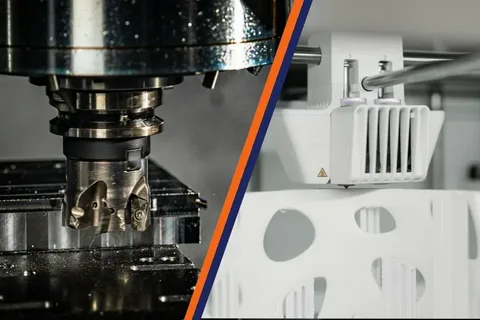
Product designers today have access to a wide range of manufacturing technologies, but two of the most influential methods are CNC machining and 3D printing. The debate around cnc machining vs 3d printing continues to grow as businesses seek faster, more cost-effective, and highly precise ways to develop products. Each technology offers unique advantages, making it essential for designers to understand their differences before selecting the right manufacturing process.
Whether you're creating prototypes, custom parts, or production-ready components, choosing between CNC machining and 3D printing can significantly impact product quality, development speed, and overall costs. This article explores expert insights into cnc machining vs 3d printing to help product designers make informed decisions.
Understanding the Basics of CNC Machining and 3D Printing
CNC machining is a subtractive manufacturing process that removes material from a solid block using computer-controlled cutting tools. The process is known for producing highly accurate parts with excellent surface finishes. Industries such as aerospace, automotive, and medical manufacturing frequently rely on CNC machining due to its precision and consistency.
In contrast, 3D printing is an additive manufacturing method that builds objects layer by layer from digital designs. It allows designers to create complex geometries that would be difficult or impossible to achieve with traditional machining methods. As technology advances, 3D printing has become increasingly popular for rapid prototyping and low-volume production.
Key Characteristics:
- CNC machining removes material from a solid workpiece.
- 3D printing adds material layer by layer.
- CNC machining delivers superior dimensional accuracy.
- 3D printing excels in creating complex shapes.
- Both methods rely on digital CAD models.
Comparing Design Flexibility and Complexity
One of the biggest considerations in the cnc machining vs 3d printing discussion is design flexibility. Product designers often need freedom to experiment with intricate shapes, internal channels, and lightweight structures. 3D printing shines in this area because it can produce highly complex geometries without requiring specialized tooling.
CNC machining, while highly versatile, faces certain limitations due to tool accessibility and cutting constraints. Features such as deep internal cavities or complex lattice structures may be difficult or impossible to machine efficiently. However, CNC machining remains ideal for designs requiring tight tolerances and smooth surfaces.
Design Advantages:
- 3D printing supports intricate and organic shapes.
- CNC machining provides exceptional precision.
- Additive manufacturing enables lightweight structures.
- CNC processes produce stronger machined edges.
- Complex internal features are easier with 3D printing.
Material Options and Product Performance
Material selection plays a major role when evaluating cnc machining vs 3d printing. CNC machining supports a wide range of materials, including aluminum, steel, brass, titanium, plastics, and engineering-grade composites. This flexibility makes CNC machining suitable for functional parts that must withstand demanding operating conditions.
While 3D printing also offers various materials, including plastics, resins, and some metals, the mechanical properties can vary depending on the printing technology used. Many printed parts may require post-processing to achieve desired strength and surface quality. However, advancements in industrial 3D printing continue to improve material performance and durability.
Material Considerations:
- CNC machining supports numerous industrial-grade materials.
- Machined parts often have superior strength.
- 3D printing provides specialized resin and polymer options.
- Metal 3D printing is expanding rapidly.
- Material choice affects durability and cost.
Cost, Speed, and Production Efficiency
Cost and production timelines are critical factors for product designers. In the cnc machining vs 3d printing comparison, 3D printing often offers lower upfront costs because it requires minimal tooling and setup. This makes it an attractive option for prototypes, custom products, and small production runs.
CNC machining may involve higher setup expenses, but it becomes more economical for medium-to-high production volumes. Additionally, CNC machines can process multiple parts efficiently while maintaining consistent quality. Designers should evaluate project requirements carefully to determine which method delivers the best return on investment.
Cost and Efficiency Factors:
- 3D printing reduces tooling costs.
- CNC machining is cost-effective for larger batches.
- Rapid prototyping is faster with 3D printing.
- CNC machining provides consistent repeatability.
- Production volume influences overall manufacturing costs.
Choosing the Right Technology for Your Product Design
The final decision in the cnc machining vs 3d printing debate depends on project goals, performance requirements, and budget constraints. Designers developing functional components with strict tolerances often prefer CNC machining because of its precision and reliability. Industries requiring regulatory compliance and consistent quality frequently choose CNC-manufactured parts.
On the other hand, designers focused on innovation, rapid iteration, and complex geometries may benefit more from 3D printing. The ability to quickly modify designs and produce prototypes accelerates product development cycles. In many cases, companies combine both technologies—using 3D printing for prototyping and CNC machining for final production.
Selection Guidelines:
- Use CNC machining for precision-critical components.
- Choose 3D printing for rapid prototyping.
- Consider CNC machining for production-scale manufacturing.
- Select 3D printing for highly complex geometries.
- Combine both technologies for optimal results.
Conclusion
The choice between cnc machining vs 3d printing is not about determining which technology is universally better; it is about selecting the right tool for the specific application. CNC machining excels in precision, material versatility, and production consistency, making it ideal for functional and production-ready parts. Meanwhile, 3D printing offers unmatched design freedom, rapid prototyping capabilities, and reduced upfront costs for low-volume manufacturing.
For product designers, understanding the strengths and limitations of both technologies is essential. By carefully evaluating project requirements, material needs, production volume, and budget, designers can leverage the best aspects of CNC machining and 3D printing to create innovative, high-quality products efficiently and cost-effectively.

 Arabic
 French
 Spanish
 Portuguese
 Deutsch
 Turkish
 Dutch
Dutch
 Italiano
 Russian
 Romaian
 Portuguese (Brazil)
 Greek
Greek