


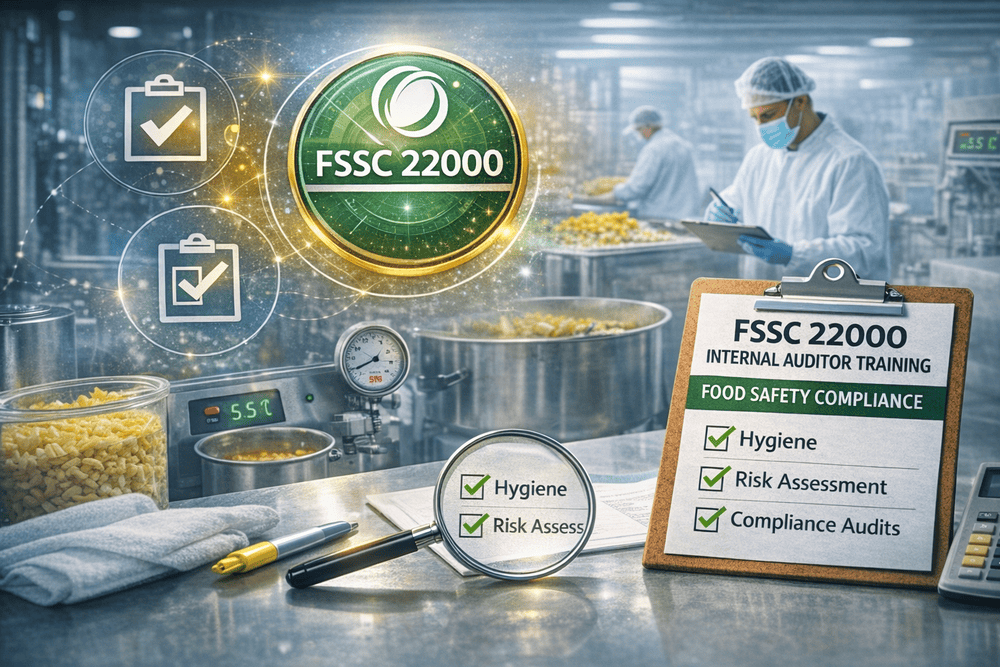
When Everything Looks Under Control… Look Again
Walk into a food production facility on a normal day and everything seems reassuring. Surfaces look clean, staff follow routines, and logs are filled out neatly. At a glance, operations appear well-managed and compliant. But food safety risks rarely present themselves in obvious ways. They develop quietly, often going unnoticed until they become serious concerns. A single cleaning step missed once, a temperature recorded slightly late, or a corrective action not fully implemented may seem minor in isolation. However, when these small gaps accumulate, they create real risks for product safety and compliance.
This is exactly where FSSC 22000 internal auditor training becomes critical. It allows hygiene and compliance teams to go beyond surface-level observations and understand what is truly happening within operations. Instead of relying only on documentation, trained auditors begin to evaluate real practices, uncover hidden gaps, and strengthen the overall food safety management system.
Understanding FSSC 22000 Internal Auditor Training in Practice
FSSC 22000 internal auditor training focuses on enabling professionals to evaluate their organization’s food safety management system from within. While many assume it revolves purely around standards and checklists, the reality is far more practical. The training equips individuals with the ability to identify gaps, assess risks, and verify whether processes actually work as intended.
Rather than simply confirming the presence of procedures, trained auditors question their effectiveness. They observe operations, engage with teams, and analyze whether documented processes align with real-world execution. This shift from “checking” to “understanding” defines the true value of the training. It transforms internal audits from routine tasks into meaningful evaluations that contribute directly to continuous improvement.
Why Hygiene and Compliance Teams Play a Central Role
Hygiene and compliance teams operate at the core of food safety. They witness daily processes, monitor cleaning practices, and handle non-conformances regularly. Their proximity to operations gives them a unique advantage—they understand how work actually gets done, not just how it is documented.
However, without structured internal auditor training, even experienced teams may approach audits as routine exercises. They may follow checklists without fully analyzing patterns or underlying issues. FSSC 22000 internal auditor training changes this dynamic completely. It helps teams convert everyday observations into actionable insights.
For example, repeated minor deviations in sanitation may indicate a deeper issue in process control or staff training. Without the right audit perspective, such patterns may go unnoticed. With proper training, hygiene and compliance teams begin to connect these dots, making audits more insightful and impactful.
Moving Beyond the Checklist-Driven Audit Culture
One of the most common challenges in internal auditing is the reliance on checklist-based approaches. While checklists provide structure, they often limit critical thinking. Auditors may focus on completing forms rather than evaluating processes.
FSSC 22000 internal auditor training encourages a shift away from this mindset. It promotes a more analytical approach where auditors assess the effectiveness of processes rather than simply verifying their existence. For instance, a sanitation log may be completed accurately, but that does not guarantee effective cleaning. A trained auditor looks deeper—examining timing, methods, and actual outcomes.
This approach ensures that audits reflect reality rather than paperwork. It also helps organizations identify risks early, preventing minor issues from escalating into major non-conformances. By moving beyond tick-box auditing, teams add real value to the food safety management system.
Key Learning Areas Covered in the Training
FSSC 22000 internal auditor training provides a comprehensive understanding of food safety systems and auditing practices. Participants gain insights into how different processes connect and influence overall compliance. Instead of focusing on isolated activities, the training emphasizes a system-wide perspective.
A significant part of the training covers the internal audit process, including planning, execution, reporting, and follow-up. Auditors learn how to structure audits effectively, ensuring consistency across departments. Risk-based auditing also plays a central role, helping auditors prioritize high-risk areas rather than treating all processes equally.
In addition, the training addresses non-conformance management, enabling auditors to identify and document issues accurately. It also focuses on root cause analysis, which helps organizations understand why problems occur instead of repeatedly fixing symptoms. The corrective action process is another critical area, emphasizing long-term solutions and verification of effectiveness.
Audit techniques for food safety further enhance an auditor’s ability to observe, question, and interpret situations. These skills are essential for identifying gaps that may not be immediately visible. Overall, the training combines theoretical knowledge with practical application, making it highly relevant to real-world operations.
The Mindset Shift That Drives Continuous Improvement
One of the most valuable outcomes of FSSC 22000 internal auditor training is the change in mindset it creates. Before training, audits often feel like tasks that need completion for compliance purposes. After training, they become part of a continuous improvement cycle.
Auditors begin to observe processes more closely, ask meaningful questions, and seek a deeper understanding of operations. This approach encourages proactive thinking rather than reactive problem-solving. Instead of waiting for external audits to identify issues, teams take ownership of their systems.
This mindset shift also fosters a culture of accountability within the organization. Employees become more aware of their roles in maintaining food safety standards. As a result, the entire system becomes more resilient and capable of adapting to changes.
Real Benefits That Develop Over Time
The benefits of FSSC 22000 internal auditor training may not appear immediately, but they become evident over time. Internal audits become more structured and consistent, ensuring that all departments follow the same approach. This consistency improves the reliability of audit findings and enhances overall system performance.
Risk identification also improves significantly. With a risk-based approach, teams can focus on areas that pose the greatest threat to food safety. This proactive strategy reduces the likelihood of major non-conformances and improves operational control.
Non-conformance management becomes more effective as well. Teams document issues clearly, analyze root causes, and implement corrective actions properly. Instead of recurring problems, organizations experience long-term improvements.
Another important benefit is improved reporting. Clear and structured audit reports help management understand issues quickly and make informed decisions. This transparency strengthens communication across the organization.
Perhaps one of the most noticeable outcomes is reduced stress during external audits. When internal systems function effectively, organizations face fewer surprises. External audits become smoother, reflecting the strength of internal processes.
The Risk of Operating Without Proper Training
Organizations that lack trained internal auditors often struggle with recurring issues. Audits may be conducted regularly, but they fail to deliver meaningful insights. The same non-conformances may appear repeatedly, indicating that root causes remain unaddressed.
Corrective actions may be implemented quickly but without proper verification. Over time, these gaps weaken the food safety management system. While problems may not surface immediately, they can lead to significant risks when they do.
FSSC 22000 internal auditor training helps prevent such scenarios. By strengthening internal audit capabilities, organizations build a more reliable and effective system. This reduces dependency on external audits and ensures continuous monitoring of processes.
Supporting Long-Term Food Safety Compliance
Food safety requirements continue to evolve, driven by regulatory updates and increasing customer expectations. Organizations must adapt to these changes while maintaining consistent operations. FSSC 22000 internal auditor training plays a crucial role in achieving this balance.
It enhances internal monitoring, ensuring that processes remain aligned with current standards. It also supports scalability, allowing organizations to maintain compliance even as they expand operations. By promoting continuous improvement, the training ensures that food safety systems remain effective over time.
Moreover, it builds confidence within teams. Employees gain a clear understanding of their responsibilities and contribute more effectively to maintaining compliance. This collective effort strengthens the organization’s overall approach to food safety.
The Human Element in Effective Auditing
Auditing is not just a technical process—it involves people. Auditors interact with colleagues, review their work, and provide feedback. Without the right approach, this can create resistance or misunderstandings.
FSSC 22000 internal auditor training addresses this aspect by improving communication skills. Auditors learn how to ask questions clearly, present findings professionally, and handle sensitive situations with care. This creates a more collaborative environment where audits are seen as opportunities for improvement rather than criticism.
When teams accept audits positively, the effectiveness of the entire process increases. This human element plays a significant role in building a strong food safety culture.
Conclusion: Building Stronger Systems from Within
FSSC 22000 internal auditor training may initially appear as a compliance requirement, but its impact extends far beyond that. It strengthens internal systems, enhances team capabilities, and transforms the way organizations approach food safety.
For hygiene and compliance teams, it provides the tools needed to move beyond routine checks and develop a deeper understanding of operations. It enables them to identify risks early, implement effective solutions, and contribute to continuous improvement.
In an industry where consistency and safety are critical, this level of understanding makes a significant difference. Strong food safety systems do not happen by chance—they result from informed actions, structured processes, and skilled professionals who know what to look for and how to respond.
FSSC 22000 internal auditor training empowers organizations to build that strength from within, ensuring long-term compliance, reliability, and confidence in their food safety practices.

 English
 Arabic
 French
 Spanish
 Portuguese
 Deutsch
 Turkish
 Dutch
Dutch
 Italiano
 Romaian
 Portuguese (Brazil)
 Greek
Greek