


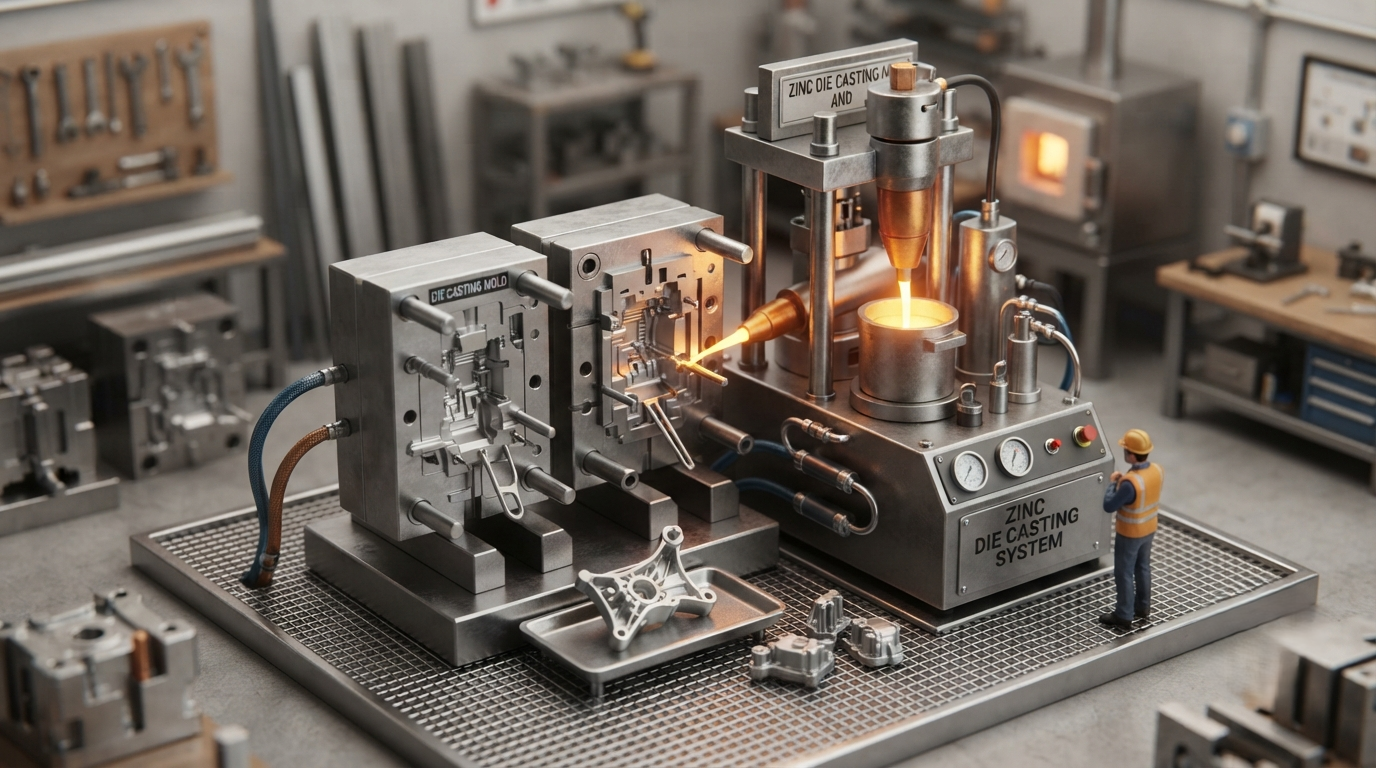
Manufacturers need metal components that combine strength, dimensional accuracy, attractive surface quality, and efficient production. Zinc Die Casting has become an important manufacturing process for producing intricate components with consistent dimensions and excellent repeatability. At the same time, a precisely engineered Die Casting Mold determines the accuracy, productivity, surface finish, and overall quality of every cast component.
From automotive hardware and electrical housings to industrial equipment and consumer products, zinc casting technology supports industries that require complex shapes and dependable production. Understanding the relationship between zinc alloys, casting machinery, mold engineering, process control, and quality inspection helps manufacturers make better production decisions while reducing unnecessary machining and material waste.
What Is Zinc Die Casting?
Zinc Die Casting is a metal manufacturing process in which molten zinc alloy is injected under pressure into a carefully designed steel mold cavity. After the metal fills the cavity and solidifies, the mold opens and the finished casting is removed.
Zinc alloys are particularly suitable for components requiring thin sections, detailed features, smooth surfaces, and tight dimensional control.
Major characteristics include:
-
Excellent dimensional repeatability
-
Complex geometric capability
-
Thin-wall manufacturing potential
-
Good surface finish
-
High production efficiency
-
Strong mechanical performance
-
Excellent finishing and plating capability
The process is particularly valuable when manufacturers require large quantities of consistent components.
How the Zinc Die Casting Process Works
A successful production cycle requires accurate control from metal preparation through component removal.
1. Mold Preparation
The Die Casting Mold is prepared and positioned inside the casting machine. Proper mold temperature and lubrication support smooth metal flow and easier component release.
2. Zinc Alloy Melting
Selected zinc alloy is heated until it reaches the required molten condition. Maintaining controlled temperature helps preserve material characteristics and casting consistency.
3. High-Pressure Injection
Molten zinc is rapidly injected into the mold cavity. Pressure allows the metal to reproduce fine details, ribs, holes, edges, lettering, and other complicated features.
4. Cooling and Solidification
Heat transfers from the molten metal into the mold. The zinc gradually solidifies into the required component geometry.
5. Part Ejection
The mold opens after adequate solidification, and ejector mechanisms remove the casting.
6. Trimming and Finishing
Excess metal, runners, gates, and flash can be removed. Depending on the application, components may undergo machining, polishing, coating, plating, painting, or assembly.
Why Die Casting Mold Design Matters
The Die Casting Mold is much more than a cavity shaped like the finished component. It is an engineered production system responsible for controlling molten-metal movement, cooling, venting, component formation, and ejection.
Important mold elements may include:
-
Mold cavity
-
Core sections
-
Gates
-
Runners
-
Overflow areas
-
Venting systems
-
Cooling channels
-
Ejector pins
Poor mold engineering can create incomplete filling, dimensional variation, excessive flash, porosity, or surface imperfections. Proper engineering improves both component quality and manufacturing productivity.
Key Benefits of Zinc Die Casting
High Dimensional Accuracy
Zinc flows effectively into detailed cavities, allowing manufacturers to create components requiring precise dimensions and complex features.
Excellent Surface Quality
Components can achieve smooth surfaces that support decorative or functional finishing processes.
Complex Component Design
Designers can integrate ribs, bosses, mounting points, holes, lettering, and other functional details into a single casting.
Efficient High-Volume Manufacturing
Once the mold and production parameters are established, Zinc Die Casting can repeatedly manufacture components using fast automated production cycles.
Reduced Secondary Operations
Near-net-shape manufacturing can reduce drilling, machining, fastening, welding, and additional assembly requirements.
Zinc Die Casting vs Conventional Machining
| Factor | Zinc Die Casting | Conventional Machining |
|---|---|---|
| Complex shapes | Excellent | Depends on tool access |
| High-volume production | Highly suitable | Often slower |
| Material utilization | Efficient | Produces machining waste |
| Surface consistency | High | High with proper machining |
| Initial tooling | Higher | Usually lower |
| Unit cost at volume | Potentially economical | Can remain relatively high |
| Integrated features | Extensive | May require multiple operations |
Neither method is universally superior. Production quantity, tolerances, geometry, material requirements, and tooling budget determine the most appropriate process.
Applications of Zinc Die Casting
The flexibility of Zinc Die Casting allows it to serve many industries.
Automotive Components
It can be used for brackets, handles, locking components, housings, interior mechanisms, and precision hardware.
Electrical and Electronics
Zinc castings are suitable for connectors, enclosures, switches, mounting components, and protective housings.
Consumer Products
Furniture hardware, appliance components, decorative fittings, handles, and everyday mechanical products can benefit from zinc casting.
Industrial Equipment
Manufacturers use zinc cast components for mechanisms, control equipment, fastening systems, precision housings, and machinery parts.
Specialized Precision Parts
A carefully engineered Die Casting Mold can reproduce small details and complex functional features that would otherwise require several manufacturing operations.
Factors That Influence Casting Quality
Consistent production requires control of several interconnected parameters:
-
Zinc alloy selection
-
Molten-metal temperature
-
Injection speed
-
Injection pressure
-
Mold temperature
-
Gate and runner design
-
Ventilation
-
Cooling efficiency
-
Component wall thickness
-
Machine stability
Ignoring one factor can affect several others. Reliable manufacturing therefore depends on process optimization rather than simply increasing injection pressure or production speed.
Quality Control in Zinc Die Casting
Quality assurance should begin before production rather than relying solely on final inspection.
Manufacturers may evaluate:
-
Dimensional accuracy
-
Surface condition
-
Component weight
-
Structural integrity
-
Assembly compatibility
-
Mechanical properties
-
Coating or plating performance
Inspection equipment such as gauges, measuring instruments, coordinate measuring systems, and application-specific testing systems can support consistent production.
Designing Components for Better Die Casting Results
Good design can improve manufacturability and extend Die Casting Mold life.
Engineers should consider uniform wall thickness, appropriate draft angles, smooth transitions, practical radii, suitable tolerances, and efficient gate positioning. Extremely sharp corners or unnecessary thickness changes can make metal flow and cooling more difficult.
Early collaboration between component designers and casting engineers can prevent expensive tooling modifications later.
Sustainability and Manufacturing Efficiency
Efficient die casting supports responsible material usage through process control, recyclable metal, optimized component weight, and reduced secondary processing.
Manufacturers can further improve efficiency by:
-
Optimizing runner systems
-
Controlling scrap generation
-
Reusing recyclable process material appropriately
-
Improving machine efficiency
-
Extending mold service life
-
Reducing rejected components
A durable Die Casting Mold also supports long production runs, reducing repeated tooling requirements.
Future of Zinc Die Casting Technology
Future manufacturing will increasingly combine automation, digital monitoring, simulation, advanced mold engineering, robotics, and real-time quality management.
Casting simulation can help engineers study molten-metal flow and solidification before tooling reaches full production. Sensors can monitor important manufacturing variables, while automated systems improve process consistency.
These technologies are making Zinc Die Casting more predictable, efficient, and suitable for increasingly sophisticated component designs.
Frequently Asked Questions
1. What is Zinc Die Casting?
Zinc Die Casting is a manufacturing process where molten zinc alloy is injected under pressure into a precision mold to create metal components.
2. What is a Die Casting Mold?
A Die Casting Mold is an engineered tool containing cavities, cores, runners, gates, cooling systems, and other features required to shape molten metal.
3. Why is zinc suitable for die casting?
Zinc offers excellent fluidity, dimensional stability, detailed feature reproduction, and strong surface-finishing capability.
4. Can zinc die casting produce complex shapes?
Yes. The process can manufacture intricate geometries, thin sections, ribs, bosses, and other integrated design features.
5. Which industries use zinc cast components?
Automotive, electronics, electrical equipment, appliances, furniture hardware, industrial machinery, and consumer-product industries commonly use them.
6. How important is mold design?
Mold design directly influences metal flow, cooling, dimensional consistency, surface quality, cycle efficiency, and component ejection.
7. Can zinc castings receive surface finishes?
Yes. Depending on the alloy and application, they can be plated, painted, polished, coated, or otherwise finished.
8. Is Zinc Die Casting suitable for mass production?
Yes. Its repeatability and rapid production cycles make it particularly effective for medium- and high-volume manufacturing.
9. What causes defects in die casting?
Potential causes include incorrect temperatures, inadequate venting, unsuitable injection conditions, poor gating, uneven cooling, or improper mold design.
10. How can manufacturers improve casting quality?
Quality can be improved through suitable alloy selection, professional tooling, controlled process parameters, preventive mold maintenance, and systematic inspection.

 English
 French
 Spanish
 Portuguese
 Deutsch
 Turkish
 Dutch
Dutch
 Italiano
 Russian
 Romaian
 Portuguese (Brazil)
 Greek
Greek