


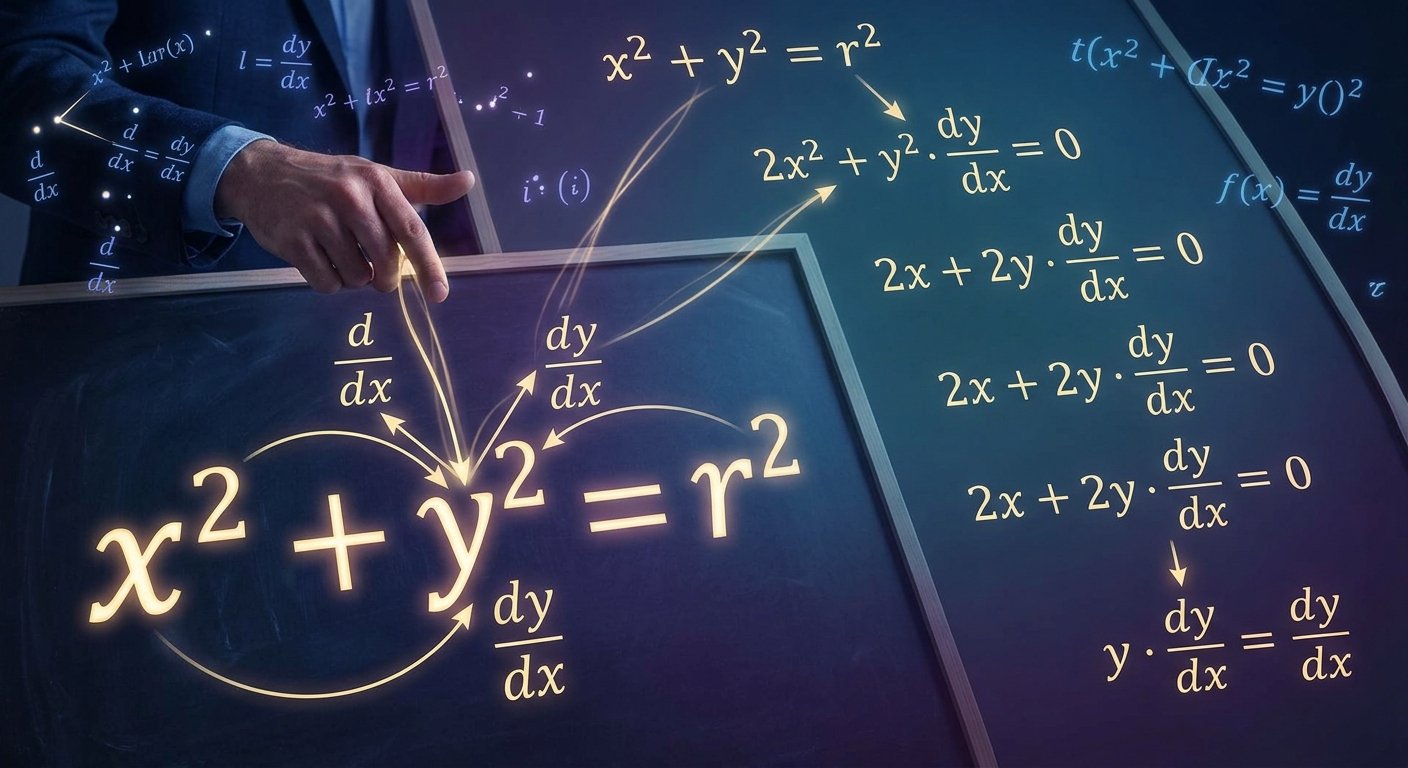
Calculus students and professionals often encounter equations where one variable cannot be easily isolated, making standard differentiation techniques difficult to apply. This is where implicit differentiation becomes essential, allowing you to find derivatives of equations that mix variables together, such as circles, ellipses, or more complex algebraic relationships. Instead of working through the process by hand, an implicit differentiation calculator can instantly compute derivatives for these tricky equations, saving time and reducing the risk of algebraic errors. Whether you're a student working through homework problems or an engineer analyzing curves, understanding how this tool works can make calculus significantly more manageable.
Understanding the Basics of Implicit Differentiation
Implicit differentiation is a technique used when a function is not explicitly solved for one variable in terms of another, requiring a different approach than standard derivative rules.
What is implicit differentiation used for?
This method is used whenever an equation defines a relationship between variables without isolating one of them, such as x² + y² = 25 for a circle. Rather than rearranging the equation to solve for y first, implicit differentiation lets you differentiate both sides with respect to x directly, treating y as a function of x throughout the process. This approach is widely applied in physics, engineering, and economics wherever variables are interdependent.
How does implicit differentiation differ from explicit differentiation?
Explicit differentiation applies when a function is already written as y = f(x), allowing direct use of standard derivative rules. Implicit differentiation, on the other hand, is necessary when such isolation is impractical or impossible, such as with equations involving both x and y raised to various powers or combined through multiplication. The key difference lies in applying the chain rule to every term containing y, since y is treated as an implicit function of x rather than a standalone variable.
Why do calculus students find implicit differentiation challenging?
Many students struggle because the process requires careful tracking of which terms need the chain rule applied and which do not, along with solving algebraically for dy/dx afterward. Mistakes often occur when the derivative of a y-term is forgotten or when terms are not properly rearranged. Practicing with a calculator that shows each differentiation step can help reinforce the correct methodology and reduce common errors.
How an Implicit Differentiation Calculator Works
These calculators use algorithms based on differentiation rules to process equations term by term and return an accurate derivative expression.
What input format do these calculators require?
Most tools ask users to enter an equation involving both x and y, such as x³ + y³ = 6xy, using standard mathematical notation. Some calculators also allow you to specify the point at which you want to evaluate the derivative, giving a numerical slope value rather than just a symbolic expression. Clear formatting, including proper use of exponents and multiplication symbols, ensures the calculator interprets the equation correctly.
Does the calculator apply the chain rule automatically?
Yes, a properly designed implicit differentiation calculator automatically identifies terms containing y and applies the chain rule by multiplying by dy/dx wherever necessary. This automation removes the tedious manual work of tracking each term and significantly speeds up the process. The tool then combines and simplifies the resulting expression algebraically to isolate dy/dx.
Can these tools show step-by-step solutions?
Many advanced calculators provide a full breakdown of each differentiation step, showing how the chain rule and product rule are applied to individual terms before the equation is solved for dy/dx. This feature is particularly valuable for students who want to verify their manual work or learn the process by comparing their steps to the calculator's output. Step-by-step solutions transform the tool from a simple answer generator into an effective learning resource.
Common Applications of Implicit Differentiation
This technique extends beyond textbook exercises into numerous real-world and academic applications where variables are naturally interconnected.
How is implicit differentiation used in related rates problems?
Related rates problems, common in calculus courses, often involve quantities that change with respect to time and are connected through an implicit equation, such as the volume and radius of an expanding balloon. Implicit differentiation allows you to differentiate the entire equation with respect to time, introducing rates of change like dx/dt and dy/dt into the resulting expression. This makes it possible to solve for an unknown rate once the other values are known.
Is implicit differentiation useful in finding tangent lines to curves?
Yes, curves defined implicitly, such as circles, ellipses, and more complex algebraic curves, require implicit differentiation to determine the slope of a tangent line at a given point. Once dy/dx is found, substituting the coordinates of the point of tangency yields the exact slope needed to write the tangent line equation. This application is especially common in analytic geometry and physics problems involving curved paths.
Do engineers and scientists use implicit differentiation in practical work?
Engineers and scientists frequently encounter equations linking multiple physical quantities where isolating one variable is impractical, such as in thermodynamics, fluid dynamics, or economic modeling. Implicit differentiation allows them to analyze how one quantity changes relative to another without needing to algebraically solve for a single variable first. This makes it a valuable tool for sensitivity analysis and optimization problems across technical disciplines.
Tips for Getting Accurate Results
Getting reliable output from an implicit differentiation calculator depends on both correct input and a solid understanding of the underlying math.
How can I avoid input errors when using the calculator?
Double-check that exponents, coefficients, and multiplication symbols are entered exactly as intended, since even small formatting mistakes can lead to incorrect derivatives. Using parentheses to group terms clearly, especially in equations with products or fractions, helps the calculator interpret your equation correctly. Reviewing the equation before submitting it can prevent wasted time troubleshooting an incorrect result.
Should I verify calculator results manually?
Even though calculators are highly accurate, working through at least a few problems manually helps reinforce your understanding of the chain rule and algebraic manipulation involved in implicit differentiation. Comparing your manual derivative to the calculator's output is a great way to catch mistakes in your own process and build confidence for exams. This practice is especially useful for students preparing for calculus assessments where calculators may not be allowed.
Read More :Thecalculators
What should I do if the calculator gives an unexpected result?
If the output seems incorrect, first check that the original equation was entered accurately, since a single misplaced symbol can drastically change the result. It also helps to simplify the equation beforehand if possible, as overly complex expressions can sometimes be misinterpreted. If the issue persists, breaking the equation into smaller parts and differentiating them separately can help identify where the discrepancy occurs.
Implicit differentiation is a foundational calculus technique that becomes far more manageable with the right digital tools at your disposal. By understanding how these calculators process equations and apply differentiation rules automatically, you can save time while still building genuine mathematical intuition. For a fast, reliable way to compute derivatives and explore other essential calculation tools, visit and simplify your calculus workflow today.

 English
 Arabic
 French
 Portuguese
 Deutsch
 Turkish
 Dutch
Dutch
 Italiano
 Russian
 Romaian
 Portuguese (Brazil)
 Greek
Greek