


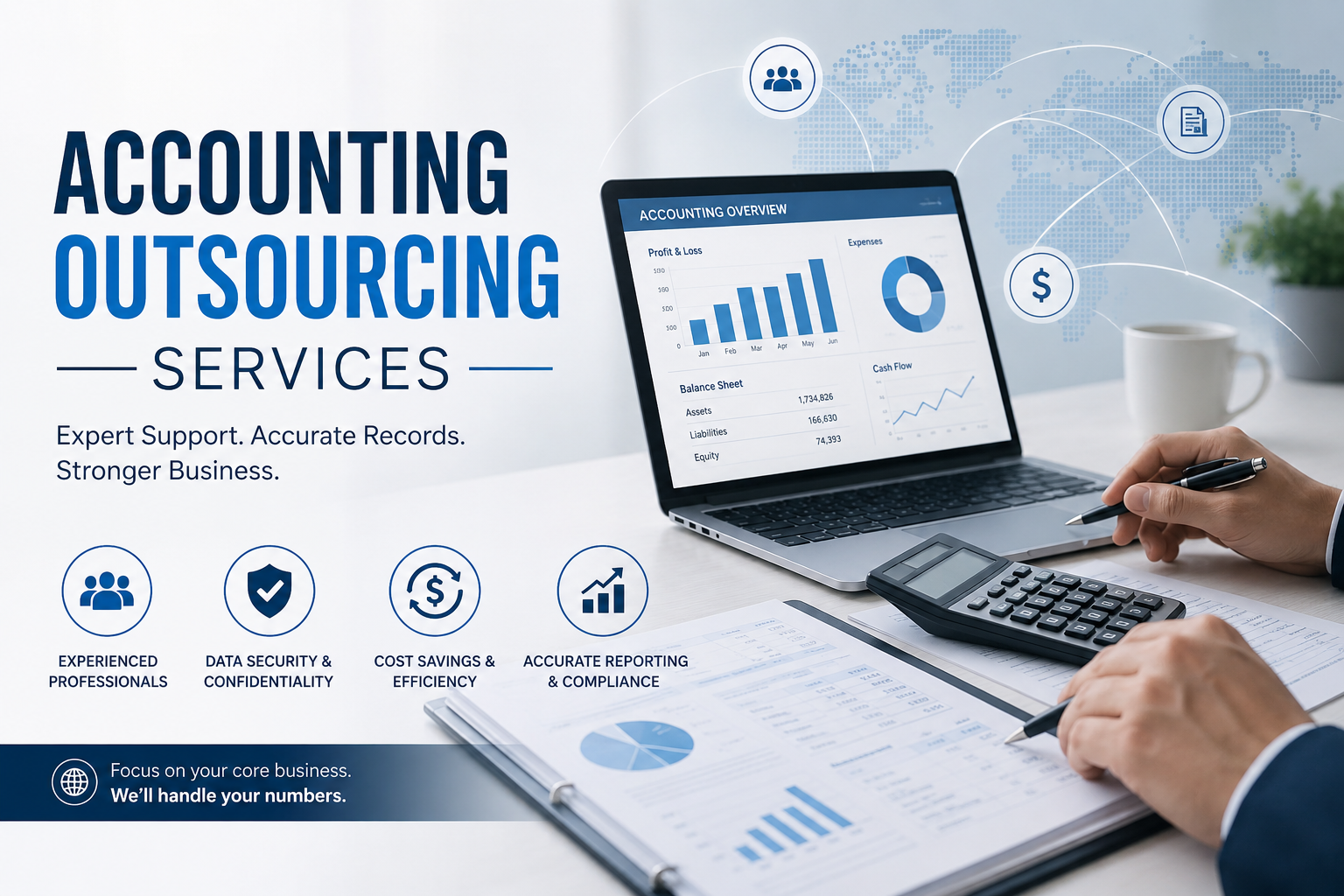
Managing business finances involves far more than keeping a record of money coming in and going out. UK businesses have to deal with bookkeeping, reporting, payroll, invoices, tax-related records and many other financial responsibilities. As these tasks become more demanding, companies often look for ways to manage them more efficiently. Accounting Outsourcing Services can provide a practical option, allowing businesses to access professional financial support without building a large in-house accounting team.
Outsourcing is not about giving up control of company finances. Instead, it allows businesses to delegate specific accounting responsibilities to an external provider while retaining control over important financial decisions. For many growing companies, this can make everyday financial administration easier to manage.
What Are Accounting Outsourcing Services?
Accounting outsourcing involves using an external accounting firm or specialist provider to manage selected financial activities on behalf of a business.
The services can vary considerably depending on the company's size and requirements. A small business may only need support with bookkeeping and financial reporting, while a larger organisation may outsource several parts of its finance function.
Common services can include:
- Bookkeeping
- Accounts payable
- Accounts receivable
- Bank reconciliation
- Payroll support
- Management accounts
- Financial reporting
- Tax preparation support
- VAT-related accounting work
- General ledger management
- Month-end accounting
- Year-end accounts support
The business can decide which responsibilities should be outsourced and which should remain with its internal team.
Why Are UK Businesses Considering Outsourcing?
The financial workload of a business can increase quickly as it grows.
More customers mean more invoices. More suppliers create additional bills. New employees increase payroll and administrative requirements. At the same time, management still needs accurate financial information for decision-making.
Hiring additional employees may seem like the obvious answer, but it is not always practical.
An external provider can give a business access to accounting expertise without necessarily requiring the company to build a larger permanent finance department.
This flexibility is one of the main reasons outsourcing appeals to small and medium-sized businesses.
Reduce the Pressure on Internal Teams
Finance teams can become overloaded when they are expected to handle every accounting task internally.
Routine work such as transaction processing, reconciliations and invoice management can take considerable time, particularly when transaction volumes are high.
Outsourcing selected responsibilities can reduce that pressure.
Internal employees can concentrate on activities that require closer involvement with the business, while external specialists manage agreed accounting tasks.
This can create a more balanced division of responsibilities.
Save Valuable Business Time
Time is an important consideration for business owners and managers.
Financial administration can take hours every week, particularly when records need to be checked, reconciled and prepared for reporting.
Outsourcing can remove some of this routine workload.
Instead of spending time chasing invoices or reviewing basic bookkeeping entries, management can focus on customers, operations, sales and growth.
The time saved can be particularly valuable for smaller companies where the owner is involved in almost every area of the business.
Improve Financial Record Keeping
Accurate records provide the foundation for good financial management.
When transactions are recorded correctly and reconciliations are completed regularly, businesses have a clearer picture of their financial position.
Outsourced accounting support can introduce a structured process for maintaining records.
This can help reduce the risk of financial information becoming outdated or incomplete.
Current records also make it easier to identify unusual transactions, outstanding payments and areas where expenses may need closer attention.
Better Visibility Over Cash Flow
Cash flow is an important concern for businesses of all sizes.
A company may have strong sales but still experience financial pressure if customers are slow to pay.
At the same time, suppliers, employees and other business costs continue to require payment.
Professional accounting support can help businesses maintain better records of receivables and payables.
This provides management with more useful information about expected income and upcoming expenses.
With clearer financial information, businesses can plan cash requirements more effectively instead of relying on assumptions.
Supporting Better Business Decisions
Financial information plays an important role in business planning.
A company considering expansion, hiring, equipment purchases or a new service needs to understand its current financial position.
If financial records are incomplete or several months behind, making those decisions becomes more difficult.
Regular accounting support can provide management with current financial information.
Reports can help show revenue, expenses, profitability and other important figures.
This information can then be used alongside professional advice when making significant business decisions.
Outsourcing Can Be Flexible
One of the advantages of accounting outsourcing is that businesses can choose the level of support they need.
A start-up may require only basic bookkeeping and monthly reporting.
A growing business may need accounts payable, accounts receivable and management accounts.
An established company could outsource a much larger part of its finance function.
This means the service can change as the business changes.
Instead of creating a fixed internal structure immediately, companies can use external support and review their requirements as transaction volumes and responsibilities develop.
Accounting Outsourcing vs Hiring In-House
There are good reasons for businesses to employ accountants internally.
A larger company with a substantial and consistent finance workload may benefit from having an accounting team working directly within the organisation.
However, an in-house team also involves recruitment, salaries, training, holiday cover and other employment responsibilities.
Outsourcing offers an alternative.
The business pays an external provider for agreed services and can potentially access a wider range of expertise without employing several specialists.
For smaller businesses, this can be particularly useful where the workload does not justify a large internal finance department.
The Importance of Cloud Accounting
Technology has changed how businesses and accounting providers work together.
Cloud accounting platforms allow authorised users to access financial information from different locations.
This can make collaboration between a business and its external accounting provider much easier.
Documents can be shared digitally, transactions can be reviewed online and financial reports can be produced without relying entirely on physical paperwork.
However, technology should be supported by sensible security procedures.
Businesses should carefully manage access to accounting systems and ensure that sensitive financial information is only available to authorised users.
Supporting Compliance and Reporting
UK businesses have a range of financial and reporting responsibilities.
The exact requirements depend on factors such as the type of business, its activities and its structure.
Keeping organised accounting records can make it easier to prepare the information needed for relevant reporting and tax processes.
An outsourced accounting provider can help maintain records and prepare financial information according to the agreed scope of work.
Businesses should still understand their responsibilities and ensure that the provider's role is clearly defined.
Outsourcing work does not remove the need for management to oversee its financial obligations.
Making Life Easier for Business Owners
Many business owners did not start their companies because they wanted to spend their days dealing with accounting administration.
Yet financial tasks can gradually take up more and more time.
Invoices need attention, expenses need recording and reports need reviewing.
By outsourcing appropriate accounting responsibilities, owners can reduce the amount of routine financial work they personally handle.
This can provide more time for customer relationships, business development and strategic planning.
The aim is not to ignore the finances but to manage them through a more efficient process.
Choosing the Right Accounting Provider
Selecting an outsourcing partner requires careful consideration.
Experience should be one of the first factors to assess. Look for a provider that understands businesses similar to yours and has experience with the services you require.
Communication is also important.
Ask who will manage your account, how often you will receive reports and how questions will be handled.
Technology should also be considered. If your company already uses a particular accounting platform, make sure the provider can work comfortably with it.
Finally, make sure the pricing and service scope are clear.
Understand what is included in the agreement and whether additional services will involve extra charges.
Data Security and Confidentiality
Accounting providers deal with sensitive information, including financial records, supplier details and potentially employee information.
Businesses should therefore ask about security before sharing their financial data.
Find out how records are stored, who can access them and how documents are transferred.
Access permissions should be reviewed regularly, especially when employees or external contractors change roles.
A reliable accounting process should protect financial information as carefully as it maintains it.
When Should a Business Consider Outsourcing?
There is no specific turnover level that means every business should outsource accounting.
Instead, look at the challenges your current finance process is creating.
Outsourcing may be worth considering if:
- Accounting tasks regularly fall behind
- Internal staff are overloaded
- Financial reports are difficult to prepare
- Invoices are not being followed up consistently
- Management lacks current financial information
- The business is growing quickly
- Hiring a full internal finance team is not practical
- Owners are spending too much time on administration
These signs suggest that the current approach may need to be reviewed.
Consider the Value, Not Just the Price
Cost is naturally an important part of the decision.
However, businesses should not compare providers based only on their monthly fees.
Consider the time saved, quality of financial information, communication and expertise provided.
A low-cost service may not offer good value if the business has to spend considerable time checking work or correcting mistakes.
The right provider should reduce administrative pressure rather than create more work.
Final Thoughts
Financial management is an important part of running a successful UK business, but not every company needs to handle every accounting responsibility internally.
For businesses dealing with increasing workloads, Accounting Outsourcing Services can provide flexible access to professional support across areas such as bookkeeping, reporting, accounts payable and receivable.
The key is to choose an experienced provider, establish clear responsibilities and maintain good communication.
When outsourcing is structured around the actual needs of the business, it can help improve financial organisation, reduce administrative pressure and give owners more time to focus on growth.
For UK businesses looking for a practical way to manage an expanding finance workload, accounting outsourcing can be a useful option worth exploring.

 English
 French
 Spanish
 Portuguese
 Deutsch
 Turkish
 Dutch
Dutch
 Italiano
 Russian
 Romaian
 Portuguese (Brazil)
 Greek
Greek