


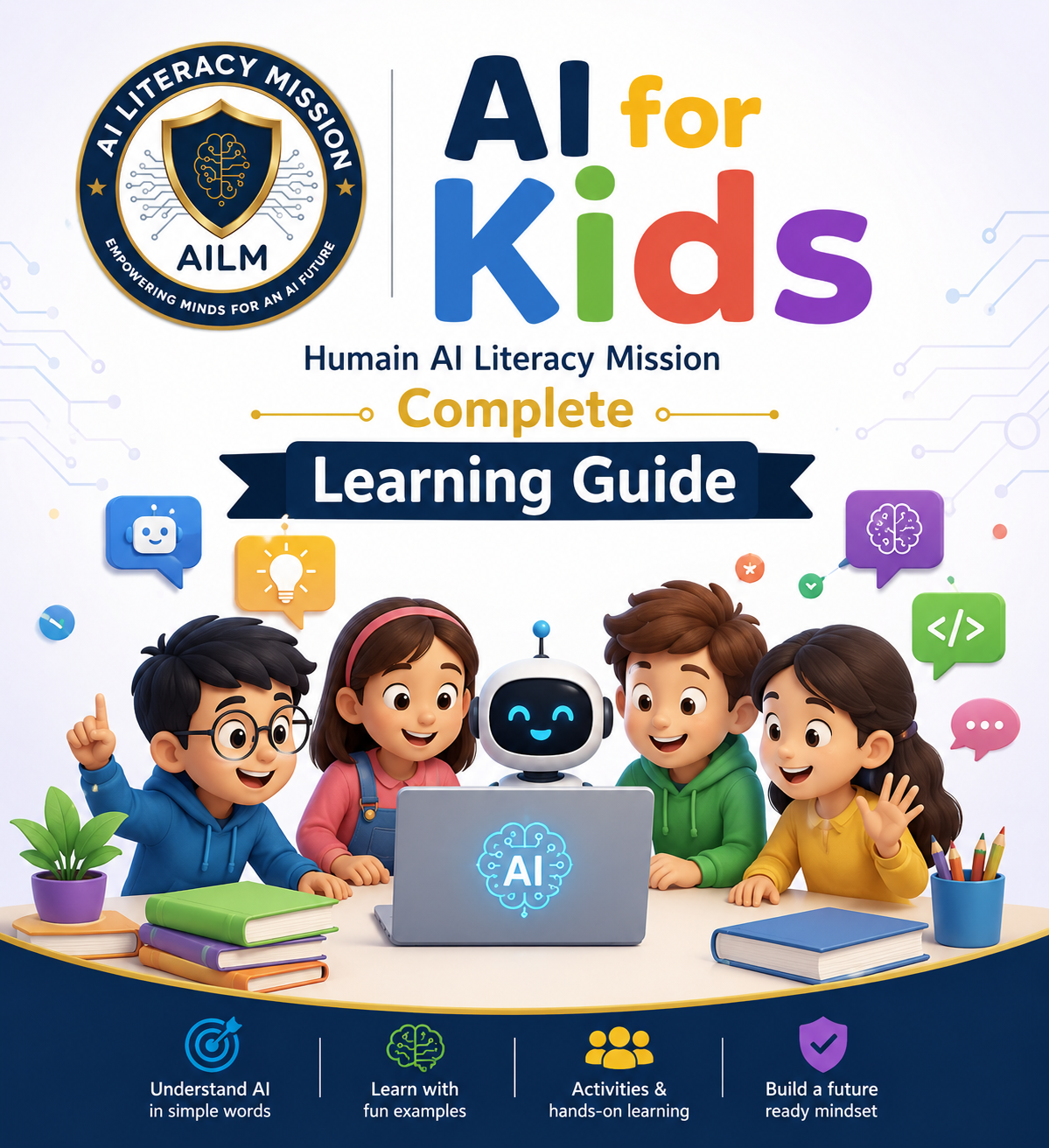
Children today are growing up surrounded by AI, whether they realize it or not from the recommendations on their favorite apps to voice assistants answering their questions. Yet very few children actually understand what AI is or how it works, and most parents aren't sure how to explain it in a way that's accurate without being overwhelming. This raises an important question: how do you introduce something as complex as Artificial Intelligence to a child in a way that's genuinely educational rather than either oversimplified or intimidating?
Why Introducing AI Early Matters
Kids Are Already Surrounded by AI
Whether it's a smart speaker, a recommendation algorithm, or a game that adapts to how they play, children interact with AI systems constantly, often without any adult explaining what's actually happening behind the scenes. Leaving this unaddressed means kids grow up using AI without understanding it a gap that becomes more significant as AI becomes even more embedded in daily life, education, and eventually their careers.
The Risk of Fear-Based or Overly Technical Approaches
Many attempts to teach AI to children swing too far in one direction either presenting AI in a way that feels frightening and mysterious, or diving into technical concepts far beyond a child's developmental stage. Both approaches tend to backfire, leaving children either anxious about technology or completely disengaged from a subject that, taught well, is genuinely fascinating.
How to Teach AI to Children the Right Way
Storytelling and Play-Based Learning
The most effective way to introduce AI to children mirrors how they learn everything else at that age: through stories, games, and hands-on play. Framing AI concepts like pattern recognition or decision-making through relatable stories and characters helps children grasp the ideas intuitively, without needing to understand the underlying math or code.
Hands-On Projects Over Passive Content
Just as importantly, children learn AI best by building something themselves, even something simple, rather than passively watching a video explanation. A child who creates their own basic chatbot or a simple AI-powered drawing tool comes away with a far deeper, more intuitive understanding than one who only watched someone else demonstrate it.
Inside Humain Learning's "Make Magic with AI" Program
A Safe, Guided Introduction to AI
This is exactly the approach behind Humain Learning's "Make Magic with AI" program, built specifically for younger learners. Using storytelling, creative projects, and simple guided activities, children explore core AI concepts in a way that feels like play rather than a technical lesson. Every activity takes place in a safe, supervised environment designed with parents' peace of mind in mind, so children can explore AI creatively without unsupervised exposure to tools meant for older users.
Parents consistently notice the difference in how their children talk about AI after completing the program not with confusion or fear, but with genuine excitement and a real, if simple, understanding of how these systems work. That shift, from passive user to curious creator, is exactly what early AI education should achieve.
Giving children a positive, age-appropriate introduction to AI now sets them up for confidence rather than confusion as the technology becomes even more present in their lives. If you're looking for a safe, engaging way to introduce your child to AI, it's worth exploring the Make Magic with AI program from Humain Learning and seeing how naturally children take to it when it's taught the right way.

 Arabic
 French
 Spanish
 Portuguese
 Deutsch
 Turkish
 Dutch
Dutch
 Italiano
 Russian
 Romaian
 Portuguese (Brazil)
 Greek
Greek