


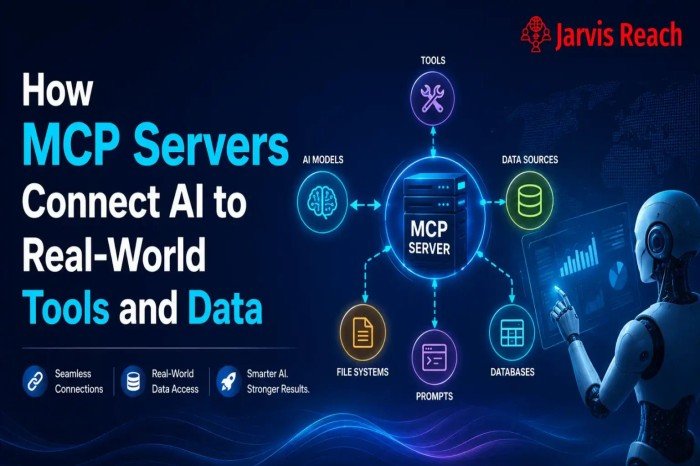
Artificial intelligence is becoming more useful when it can work with real-time information, business applications, and external tools. An MCP Server provides a structured way for AI applications to connect with different resources, including APIs, SQL databases, enterprise data, file systems, and other data sources.
By creating a common connection between AI platforms and external resources, MCP Server can simplify AI integrations and help developers build more capable applications.
What Is MCP Server?
MCP Server, based on the Model Context Protocol, provides a standardized way for AI applications to communicate with external tools and resources.
Instead of creating a separate custom integration for every service, developers can use MCP-based connections to expose useful capabilities to an AI application.
An MCP Server may provide access to:
- Business data
- APIs
- Databases
- Files
- Applications
- External tools
- Internal company resources
This makes AI systems more useful because they can work with information beyond their built-in knowledge.
How Does MCP Server Work?
An MCP setup typically includes an AI application, an MCP Client, and one or more MCP Servers.
The general workflow is:
- A user sends a request to an AI platform.
- The AI application determines what information or tool is needed.
- The MCP Client communicates with the appropriate MCP Server.
- The server accesses the requested resource.
- The result is returned to the AI application.
- The AI uses the information to produce a response.
This architecture creates a flexible connection between AI models and external systems.
What Is an MCP Client?
The MCP Client is the component that communicates with MCP Servers on behalf of an AI application.
It can help an AI platform discover and use available server capabilities, such as tools, resources, and prompts.
For example, an AI assistant may use an MCP Client to request customer information from a business system through an MCP Server.
MCP Server and APIs
API integration is one of the most useful applications of MCP Server technology.
APIs allow software systems to communicate with one another. An MCP Server can expose API-based capabilities so that an AI application can interact with external services.
Potential use cases include:
- CRM systems
- Marketing platforms
- Analytics services
- Cloud applications
- Business automation tools
- Internal software
This can help developers create AI assistants that perform tasks rather than simply answer questions.
Enterprise Data and AI
Modern organizations store valuable information across many systems. Enterprise data can include customer records, business reports, documents, product information, and internal knowledge.
Connecting AI with enterprise data can help organizations:
- Find information faster
- Automate repetitive tasks
- Generate useful reports
- Improve decision-making
- Build internal AI assistants
Access should always be controlled carefully when sensitive company information is involved.
SQL Databases and Data Sources
Many businesses rely on SQL databases to store structured information. MCP Server can provide a controlled way for AI applications to interact with database-related tools or resources.
For example, an AI assistant could potentially retrieve approved business information and use it to answer a user's question.
MCP can also work with different data sources, allowing AI applications to access information from multiple systems through a consistent architecture.
Prompt Templates
Prompt templates can make AI workflows more consistent by providing predefined instructions.
They can be useful for:
- Customer support
- Data analysis
- Content generation
- Internal documentation
- Business reporting
Reusable prompts can reduce repetitive work and help teams standardize how AI applications handle specific tasks.
Authentication and Security
When an AI application connects to external resources, authentication is essential.
Authentication can help verify:
- Which user is making a request
- Which application is connecting
- What resources can be accessed
- Which actions are permitted
A secure MCP implementation should use appropriate access controls, protect credentials, and limit permissions to only what is required.
API keys and other credentials should never be exposed in public posts, repositories, or screenshots.
Stateful and Stateless MCP Applications
MCP-based applications can be designed around different session requirements.
Stateless Architecture
A stateless system treats each request independently and does not rely on stored session information.
Advantages can include:
- Easier scaling
- Simpler infrastructure
- Flexible deployment
- Reduced session management
Stateful Architecture
A stateful system maintains information about an ongoing interaction or session.
This can be useful when an application needs:
- Conversation continuity
- Session information
- Personalized workflows
- Ongoing task context
The appropriate architecture depends on the application's requirements.
MCP Server and Backends
AI applications often depend on multiple backends, including databases, internal services, APIs, and business applications.
MCP Server can act as a structured connection layer between these backend resources and AI applications.
This can make it easier to build AI-powered workflows that interact with existing business infrastructure instead of replacing it.
File Systems and AI
File systems contain valuable information such as documents, reports, spreadsheets, and text files.
An MCP Server can provide controlled access to file-related tools or resources so that an AI application can work with approved documents.
Potential applications include:
- Document search
- File analysis
- Knowledge management
- Internal research
- Automated document workflows
File access should be carefully restricted to prevent unauthorized exposure of sensitive information.
Benefits of MCP Server
MCP Server can provide several advantages for AI development:
- Standardized connections
- Easier AI integrations
- Access to external tools
- Enterprise data connectivity
- API integration
- Database interaction
- Reusable prompts
- Flexible application architecture
These capabilities can help developers build AI applications that interact with real-world systems.
MCP Server Use Cases
MCP Server can support many types of AI applications.
Customer Support
An AI assistant can connect with approved customer information and support tools to provide more useful responses.
Business Intelligence
AI applications can access approved business data and help users analyze reports and operational information.
Developer Tools
Developers can connect AI assistants with software development tools, documentation, and project resources.
Knowledge Management
Organizations can connect AI applications with internal documents and other knowledge sources.
Workflow Automation
AI systems can interact with connected tools to automate repetitive business processes.
Best Practices for MCP Server
Organizations should follow security and development best practices when implementing MCP Server.
Important considerations include:
- Use strong authentication.
- Apply least-privilege access.
- Protect API credentials.
- Validate tool inputs.
- Monitor server activity.
- Restrict file access.
- Keep dependencies updated.
- Review connected data sources regularly.
Security should be considered from the beginning rather than added after deployment.
Future of MCP Server
As AI applications become more connected, the ability to access external information and tools will become increasingly important.
MCP Server provides a structured approach for connecting AI platforms with APIs, databases, enterprise systems, and other resources. This can help developers build applications that are more useful than standalone AI models.
The future of AI will likely involve systems that can understand requests, retrieve relevant information, and interact with approved tools while maintaining appropriate security controls.
Conclusion
MCP Server provides a flexible way to connect AI applications with external systems and information. Through an MCP Client, AI platforms can interact with APIs, enterprise data, SQL databases, data sources, prompt templates, backends, authentication systems, and file systems.
Whether an application requires a stateful or stateless architecture, MCP can provide a structured foundation for building connected AI workflows. With careful authentication, access control, and resource management, MCP Server can help developers create secure, scalable, and intelligent AI applications.

 English
 Arabic
 French
 Portuguese
 Deutsch
 Turkish
 Dutch
Dutch
 Italiano
 Russian
 Romaian
 Portuguese (Brazil)
 Greek
Greek