


Introduction
A Netflix clone app is not just a video player with a subscription button. It is a complete OTT business system where content, payments, user profiles, recommendations, watch history, producer payouts, admin control, and audience retention all work together.
Streaming has already become a mature digital business model. Netflix reported $45.18 billion in total revenue for 2025, up 16% from 2024, with operating income of $13.33 billion and a 29.5% operating margin. That shows how powerful a well-structured streaming ecosystem can become when content, technology, pricing, and user experience are aligned.
For startups, studios, broadcasters, educators, creators, and niche content owners, the opportunity is not to “become Netflix overnight.” The smarter opportunity is to build a focused streaming platform for a specific audience, genre, region, language, or community.
What Is a Netflix Clone App?
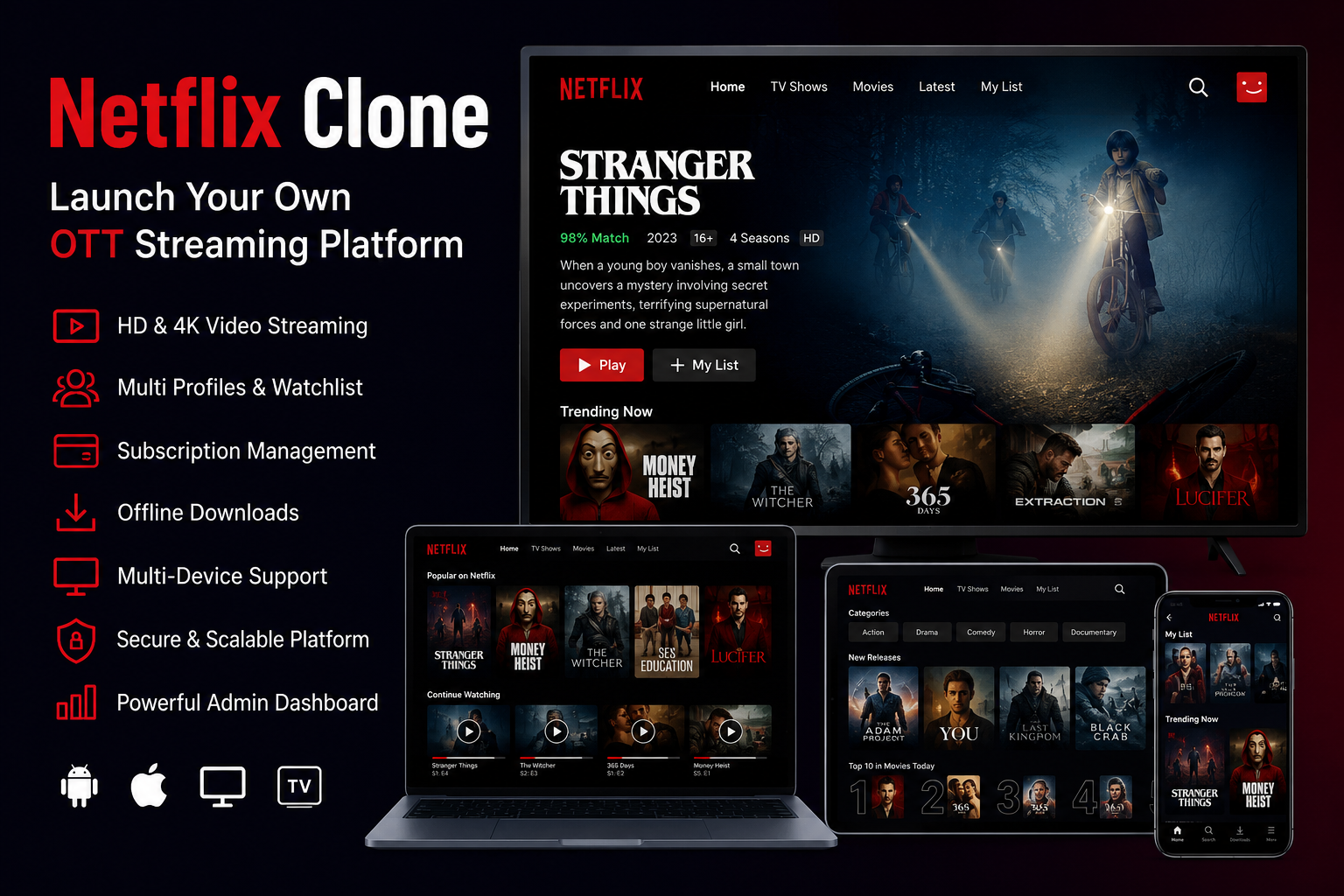
A Netflix clone app is a ready-made OTT and video-on-demand platform that allows a business to launch its own branded streaming service. It usually includes web, Android, and iOS apps, video playback, content catalog management, subscriptions, rentals, user profiles, watchlist, Continue Watching, search, admin control, and monetization workflows.
Miracuves describes its Netflix clone as a white-label OTT and VOD platform with movies, series, episodes, videos, live TV, subscriptions, rentals, profiles, watchlist, Continue Watching, search, playback, admin control, producer onboarding, revenue sharing, pay-per-view rentals, API access, and source-code ownership.
This matters because streaming success depends on more than uploading videos. A serious platform needs business logic behind every viewer action: who can watch, how long they can access content, whether the content is free or paid, how producers are paid, what content appears on the homepage, and how admins control the full system.
Why Streaming Startups Need More Than a Basic Video App
Many founders think the hardest part of a Netflix-like app is video playback. In reality, playback is only one layer. The bigger challenge is building a system that can manage users, content, plans, payments, analytics, access control, and retention.
A basic video app may let users watch content. A real OTT platform helps the business answer deeper questions:
Which shows are users watching most?
Where do users stop watching?
Which subscription plan converts better?
Which producer content earns more engagement?
Which regions need localized content?
Which content should appear on the homepage?
Which users are likely to cancel?
These questions shape revenue. That is why the backend, admin dashboard, analytics, and monetization logic are just as important as the frontend design.
Key Features of a Strong Netflix Clone App
A competitive Netflix clone app should offer a smooth viewing experience across devices. Users should be able to create accounts, manage profiles, browse content, search titles, save watchlists, resume videos, choose quality, use subtitles, and pay for subscriptions or rentals.
Important viewer-side features include:
- User registration and login
- Multiple viewer profiles
- Kids profile and parental control
- Movies, shows, seasons, episodes, and trailers
- Watchlist or My List
- Continue Watching
- Search and category filters
- Subtitle and quality selection
- Subscription plans
- Rentals and pay-per-view access
- Live TV or event streaming
- Payment history and invoices
The Miracuves Netflix clone page also highlights advanced playback, live TV, subscription plans, rentals, pay-per-view, producer dashboard, watch-minute revenue sharing, and configurable white-label features that can be enabled or extended based on the OTT business model.
Admin Dashboard: The Real Control Room
The admin dashboard is where the streaming business is managed. Without a powerful admin panel, the platform owner cannot control content, users, plans, payments, producers, or platform settings properly.
A good admin dashboard should allow the business to:
- Upload and manage movies, shows, episodes, and live TV
- Create subscription plans and rental rules
- Approve or reject producer content
- Manage banners, categories, and homepage sections
- Track users, payments, coupons, and reports
- Handle payout approvals
- Control platform settings and access rules
Miracuves lists an OTT control center and admin dashboard that manages users, content, subscriptions, rentals, coupons, producers, payouts, approvals, banners, live TV, reports, roles, settings, and platform configuration.
This is important because streaming platforms are not static websites. They are living content businesses. New content is added, old content is removed, plans change, campaigns run, producers need payouts, and users expect a polished experience every time they log in.
Producer Panel: A Smarter Way to Grow the Content Library
One of the biggest challenges in OTT is content supply. If the platform depends only on its own content, growth can become slow and expensive. A producer panel solves this by allowing studios, creators, instructors, distributors, and content partners to submit content and track performance.
A producer panel can include content submission, metadata upload, media management, analytics, revenue reports, payout requests, and approval workflows. Miracuves highlights a producer dashboard where content partners can submit content, track views, watch minutes, revenue share, and payouts under admin approval.
This makes the Netflix clone model more flexible. Instead of building only a single-brand content app, the platform can become a marketplace for video content. That works well for regional OTT, education platforms, creator networks, independent film platforms, fitness streaming, faith-based content, and niche entertainment communities.
Monetization Models for a Netflix-Like Platform
A Netflix clone app can support several revenue models. The most common model is SVOD, where users pay a recurring monthly or yearly subscription for access to a content library.
Another model is TVOD, where users rent or purchase specific titles. This is useful for premium movies, special events, documentaries, courses, concerts, or sports replays.
Pay-per-view is also valuable for live events, exclusive releases, tournaments, webinars, and limited-access content. Some platforms also use advertising, premium bundles, coupons, producer revenue sharing, and hybrid monetization.
Common OTT monetization models include:
- Subscription video on demand
- Pay-per-view access
- One-time rentals
- Live event passes
- Ad-supported content
- Premium content bundles
- Producer revenue sharing
- Regional or niche membership plans
Miracuves states that the platform supports SVOD subscriptions, TVOD rentals, PPV access, live TV, ad-based revenue, premium content bundles, and producer revenue sharing based on minutes viewed.
Why Niche Streaming Can Be More Practical Than Competing With Netflix
A new streaming startup should not try to compete with Netflix on global catalog size. That would require massive content spending, international licensing, strong brand recognition, and years of user trust.
A better strategy is niche ownership.
For example, a founder can build a streaming platform for:
- Regional-language movies
- Independent films
- Fitness and wellness videos
- Kids and family content
- Faith-based content
- Professional learning
- Sports replays and live events
- Creator-led documentaries
- Local culture and community content
- Corporate training and internal learning
Niche streaming works because the audience is clearer. Marketing becomes easier. Content strategy becomes sharper. The platform does not need everything for everyone. It needs the right content for a defined group of people.
Technology Requirements Behind a Netflix Clone App
A Netflix clone app needs more than attractive screens. It requires a strong technical foundation for streaming, user access, payments, cloud delivery, content management, and analytics.
Important technical layers include:
- Secure backend and APIs
- Cloud or CDN-ready video delivery
- User authentication
- Subscription billing integration
- Payment gateway support
- Video encoding and playback workflows
- Content management system
- Admin dashboard
- Analytics and reporting
- Role-based access control
- Mobile and web app support
- Scalable database structure
Miracuves describes its Netflix clone as using scalable streaming architecture with secure APIs, profile-based viewing, watchlists, Continue Watching, video delivery workflows, cloud/CDN-ready deployment, and admin-controlled platform operations.
For serious OTT businesses, scalability matters from the start. If the app gains traffic during a new release, live event, or marketing campaign, the platform must handle users without buffering issues, payment errors, or broken sessions.
Content Discovery Is the Difference Between Watching and Leaving
A streaming app can have great content, but users will leave if they cannot find what to watch. This is why discovery features are critical.
Home banners, trending rows, new release sections, genre shelves, cast and crew pages, search filters, personalized watch history, and Continue Watching all help users move faster from browsing to watching.
The goal is to reduce decision fatigue. Users should not feel lost inside the app. The platform should guide them toward content that matches their interest, profile, language, and viewing behavior.
Final Thoughts
A Netflix clone app gives founders a faster path to launch a branded OTT platform, but the real success comes from strategy. The app must combine smooth playback, strong admin control, flexible monetization, producer workflows, content discovery, user retention, and scalable infrastructure.
The best opportunity is not to copy Netflix directly. The best opportunity is to build a focused streaming business for a specific audience that wants content they cannot easily find elsewhere.
For startups, studios, broadcasters, creators, educators, and regional media companies, a Netflix clone app can become the foundation for audience ownership, recurring revenue, and long-term content-led growth.

 English
 Arabic
 French
 Spanish
 Portuguese
 Deutsch
 Turkish
 Dutch
Dutch
 Italiano
 Russian
 Portuguese (Brazil)
 Greek
Greek