


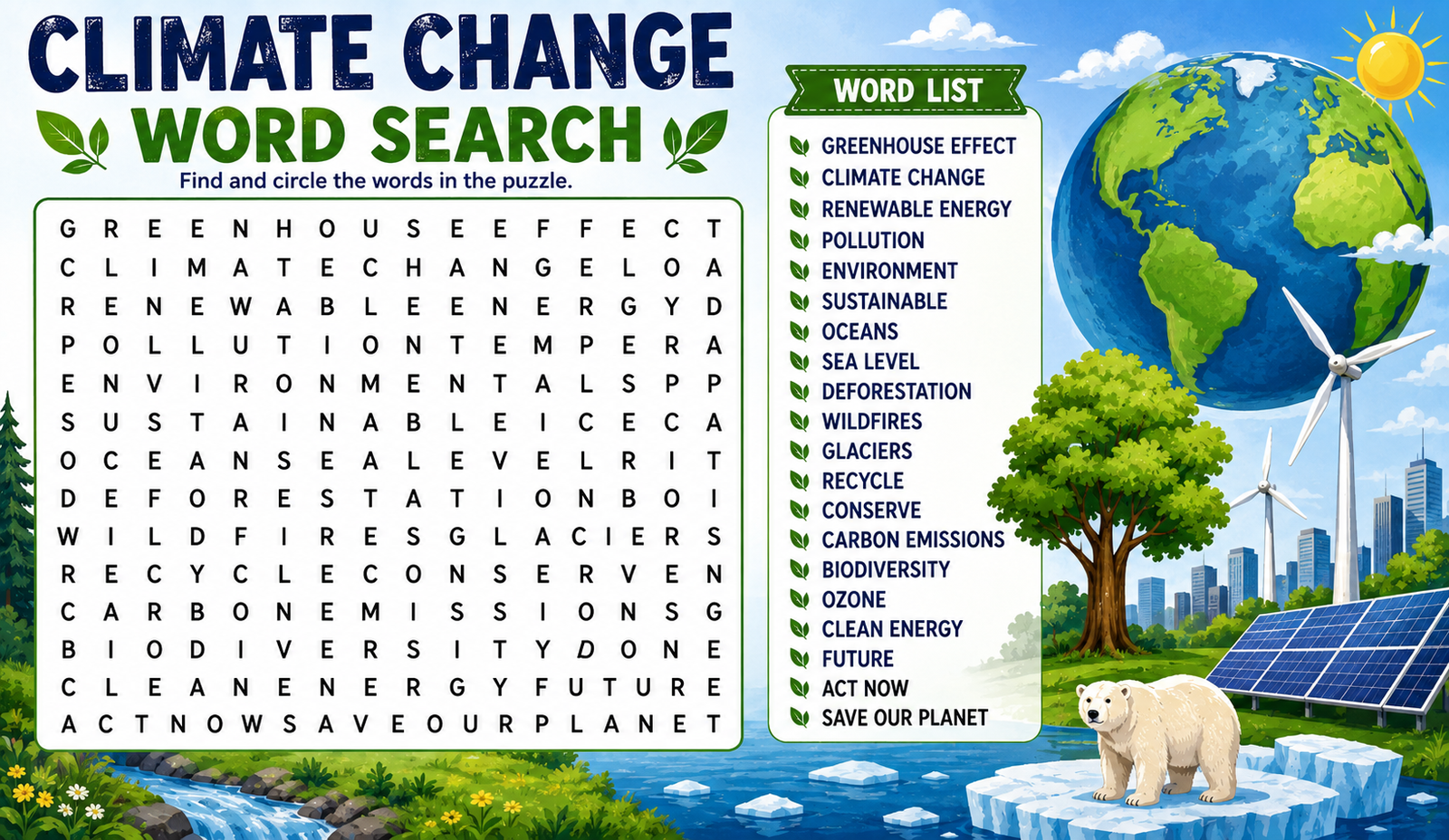
Climate Change Word Search: An Engaging Way to Learn the Language of Our Planet's Biggest Challenge
Climate change is the defining issue of our generation. From rising sea levels and melting glaciers to extreme weather events and shifting ecosystems, the effects of a warming planet are being felt in every corner of the world. Yet despite the urgency of the issue, many people — including students, adults, and even engaged citizens — struggle to fully understand the scientific and environmental vocabulary that surrounds the climate crisis. Terms like GREENHOUSE GAS, CARBON FOOTPRINT, BIODIVERSITY, and PERMAFROST appear constantly in news reports, policy documents, and scientific studies, yet remain unfamiliar or poorly understood by a large portion of the general public. That is exactly where the climate change word search steps in as a powerful, accessible, and surprisingly effective educational tool.
By embedding essential environmental and climate vocabulary into an engaging puzzle format, a climate change word search makes learning the language of our planet's greatest challenge feel approachable, enjoyable, and memorable. Whether used in a school classroom, a community workshop, a family setting, or as a personal learning activity, a well-designed climate change word search opens the door to deeper understanding of the issues that will shape the future of life on Earth.
Why Learning Climate Change Vocabulary Is So Important
Before exploring the puzzle itself, it is worth pausing to consider why climate vocabulary matters so deeply. The climate crisis is not just a scientific issue — it is a political, economic, social, and moral challenge that demands informed participation from citizens at every level of society. From voting on environmental policies to making personal choices about energy consumption, transportation, and diet, the decisions people make are shaped by how well they understand the concepts and vocabulary that define the debate.
When someone hears the term CARBON SEQUESTRATION in a political speech and does not understand it, they are less equipped to evaluate whether the policy being proposed is genuinely effective or merely cosmetic. When a student encounters ALBEDO or METHANE in a science textbook without prior familiarity, the cognitive load of simultaneously decoding vocabulary and grasping concepts slows down comprehension significantly. When a community activist tries to communicate the urgency of DEFORESTATION or OCEAN ACIDIFICATION to neighbours who have never encountered these terms, the message is harder to convey and harder to retain.
Building strong climate vocabulary is therefore not just an academic exercise — it is a form of civic empowerment. And the climate change word search, by creating repeated, enjoyable exposure to key terms, is one of the most effective and accessible ways to begin building that vocabulary foundation.
Essential Climate Change Terms Every Word Search Should Include
A comprehensive climate change word search should span the full range of environmental and scientific vocabulary related to global warming and its consequences. Here is a detailed breakdown of the most important categories and terms that belong in a well-constructed puzzle.
Greenhouse Gases and Atmospheric Terms
The science of climate change begins in the atmosphere, and the vocabulary surrounding it is fundamental to any climate education. A word search covering this category should feature terms like GREENHOUSE, CARBON, DIOXIDE, METHANE, OXYGEN, NITROGEN, OZONE, ATMOSPHERE, EMISSIONS, AEROSOL, SMOG, POLLUTION, FOSSIL FUELS, COMBUSTION, and CONCENTRATION. These are the words that describe the invisible chemical processes driving global temperature rise, and building visual familiarity with them through a puzzle is an excellent first step toward genuine scientific understanding.
Climate Phenomena and Weather Events
Climate change manifests in the physical world through increasingly dramatic weather events and long-term environmental shifts. A climate phenomena word search would include terms such as HEATWAVE, DROUGHT, FLOOD, HURRICANE, CYCLONE, TORNADO, WILDFIRE, BLIZZARD, MONSOON, TYPHOON, EL NINO, LA NINA, PRECIPITATION, EVAPORATION, CONDENSATION, HUMIDITY, and TEMPERATURE. Finding HURRICANE or WILDFIRE in a puzzle grid creates a direct visual connection between abstract climate science and the real-world events that appear in news coverage every week.
Ice, Oceans, and Water Systems
Some of the most dramatic and visible consequences of climate change involve the world's ice sheets, glaciers, and ocean systems. A word search focused on this category would feature GLACIER, ICEBERG, PERMAFROST, ARCTIC, ANTARCTIC, SEA LEVEL, MELTING, SNOWPACK, TUNDRA, OCEAN, ACIDIFICATION, CORAL, BLEACHING, SALINITY, CURRENT, TIDE, and EROSION. Words like PERMAFROST and ACIDIFICATION are particularly valuable inclusions because they describe phenomena that are central to the climate crisis yet often unfamiliar to the general public.
Biodiversity and Ecosystems
Climate change is not just about temperature — it is about the cascading effects on living systems across the planet. An ecosystem-focused climate word search should include BIODIVERSITY, ECOSYSTEM, HABITAT, SPECIES, EXTINCTION, MIGRATION, DEFORESTATION, REFORESTATION, RAINFOREST, WETLAND, MANGROVE, SAVANNA, TUNDRA, CORAL REEF, POLLINATOR, and FOOD WEB. Each of these terms represents a dimension of the climate crisis that goes beyond atmospheric chemistry and connects to the living world in immediate, visceral ways.
Renewable Energy and Clean Technology
The solutions to climate change are as important as the problems themselves, and the vocabulary of clean energy deserves a prominent place in any climate change word search. Terms like SOLAR, WIND, HYDROPOWER, GEOTHERMAL, BIOMASS, TIDAL, BATTERY, STORAGE, TURBINE, PANEL, GRID, EFFICIENCY, HYDROGEN, ELECTRIC, CARBON NEUTRAL, NET ZERO, and RENEWABLE give learners a vocabulary for understanding and discussing the energy transition that is already underway across the world. A solutions-focused word search is particularly important for younger learners because it frames the climate crisis as a challenge with real, achievable answers rather than an overwhelming catastrophe.
Climate Policy and International Terms
Climate change is ultimately a global governance challenge as much as a scientific one, and the vocabulary of international climate policy deserves inclusion in a comprehensive word search. Terms such as PARIS AGREEMENT, KYOTO, PROTOCOL, EMISSIONS, CARBON TAX, CAP AND TRADE, OFFSET, ADAPTATION, MITIGATION, RESILIENCE, VULNERABILITY, JUSTICE, EQUITY, SUSTAINABILITY, and COMMITMENT reflect the political and diplomatic dimensions of addressing climate change at a global scale.
Carbon and Footprint Vocabulary
Personal and corporate carbon footprints have become a central concept in public climate discourse, and the vocabulary surrounding carbon measurement and reduction deserves its own category. A carbon-focused word search would include FOOTPRINT, CARBON, OFFSET, SEQUESTRATION, CAPTURE, STORAGE, NEUTRAL, NEGATIVE, SINK, SOURCE, LIFECYCLE, SCOPE, INTENSITY, BUDGET, and PATHWAY. These terms appear constantly in corporate sustainability reports, consumer product labelling, and climate journalism, making familiarity with them genuinely useful in everyday life.
Climate Change Word Searches in Educational Settings
The climate change word search is an exceptionally versatile educational tool that fits naturally into a wide range of learning environments and age groups. Here is how different audiences can benefit most from its use.
Primary School Students: Young children are increasingly aware of climate change through media, conversations at home, and their own observations of the natural world. A climate word search designed for primary school learners — featuring accessible terms like SUN, RAIN, WIND, FLOOD, TREE, SEA, and ICE in a simple 10x10 grid — introduces climate vocabulary at a developmentally appropriate level while opening the door to meaningful conversations about nature and the environment. The puzzle format makes the subject feel engaging rather than frightening, which is critically important when educating young children about a topic that can easily provoke anxiety.
Secondary School and High School Students: Older students studying geography, biology, chemistry, or environmental science encounter climate vocabulary in a far more technical and demanding context. A climate change word search designed for this age group can feature longer, more complex terms like PHOTOSYNTHESIS, STRATOSPHERE, BIOGEOCHEMICAL, and ANTHROPOGENIC alongside more widely known words. Using the word search as a pre-lesson vocabulary primer or a post-lesson review activity reinforces the technical language that students must master to succeed in science examinations and coursework.
University and College Students: At the tertiary level, climate change intersects with economics, law, political science, engineering, and urban planning in addition to the natural sciences. A university-level climate word search featuring terms like EXTERNALITY, GEOENGINEERING, DECARBONISATION, STRANDED ASSETS, and CLIMATE FINANCE reflects the interdisciplinary vocabulary that students across multiple faculties need to engage with climate issues in their specific professional contexts.
Community and Adult Learners: Libraries, community centres, environmental organisations, and adult education programs can use climate change word searches as accessible entry points for adult learners who want to become more informed and engaged on climate issues. The puzzle format removes the intimidation factor that academic vocabulary can create and replaces it with the comfortable familiarity of a well-known activity format. A completed climate word search is also a natural conversation starter — an invitation to discuss what each discovered term means and why it matters.
The Emotional Dimension of Climate Education
Teaching about climate change presents a unique emotional challenge that distinguishes it from almost every other educational topic. The scale and urgency of the climate crisis can provoke feelings of anxiety, grief, helplessness, and despair — particularly in young people who are acutely aware that they will live with the consequences of decisions being made today.
The climate change word search addresses this emotional dimension in a subtle but meaningful way. By presenting climate vocabulary in a calm, structured, game-like format, it creates a psychological space where learners can engage with difficult concepts without feeling overwhelmed. The small, repeated victories of finding words in a grid — SOLAR, RESILIENCE, REFORESTATION, RENEWABLE — build a sense of agency and mastery that counterbalances the helplessness that climate anxiety so often generates.
This is not to suggest that a word search can resolve the profound emotional challenges of climate education. But it can serve as a gentle, stabilising entry point — a way of making the vocabulary of climate change feel familiar and manageable before engaging with the deeper scientific, political, and ethical dimensions of the issue.
How to Design a Powerful Climate Change Word Search
Creating your own It wordsearch is a straightforward process that any teacher, parent, or environmental educator can undertake. A few key principles will help you design a puzzle that is both educationally effective and genuinely engaging.
Choose a specific focus. Rather than trying to cover all of climate change in a single puzzle, design each word search around a specific theme — greenhouse gases, renewable energy, biodiversity, or climate policy. This focus makes the vocabulary more coherent, the learning more targeted, and the puzzle more meaningful.
Scale the vocabulary to your audience. Match the complexity of your word list to the age and knowledge level of your intended solvers. Simple terms for younger learners, technical terms for older students and professionals. A word search that is too easy offers insufficient challenge; one that is too difficult creates frustration rather than learning.
Use the word bank as a teaching moment. Add brief definitions or contextual clues alongside each word in the bank. This small addition transforms the word search from a pure recognition exercise into a genuine comprehension activity that builds understanding as well as familiarity.
Connect the puzzle to action. After completing a climate change word search, encourage learners to choose one term they found and research one real-world action connected to it. Found SOLAR? Research solar panels. Found REFORESTATION? Learn about tree-planting initiatives. This connection between vocabulary and action keeps climate education from remaining purely abstract.
Conclusion
The climate change word search is a small but genuinely powerful tool in the effort to build the global climate literacy that our times demand. In a world where the language of climate science, policy, and solutions is becoming increasingly central to public discourse, education, and professional life, building strong environmental vocabulary is an act of both personal empowerment and civic responsibility.
By making that vocabulary accessible, enjoyable, and memorable through the simple elegance of a word search puzzle, we lower the barriers to climate understanding for learners of every age, background, and ability. One hidden word at a time, a climate change word search helps build the informed, engaged, and vocabulary-equipped citizenry that addressing this global challenge will ultimately require. Pick up a pencil, find your first word, and take your first small step toward understanding the language of our planet's future.

 English
 Arabic
 French
 Spanish
 Portuguese
 Deutsch
 Turkish
 Italiano
 Russian
 Romaian
 Portuguese (Brazil)
 Greek
Greek