


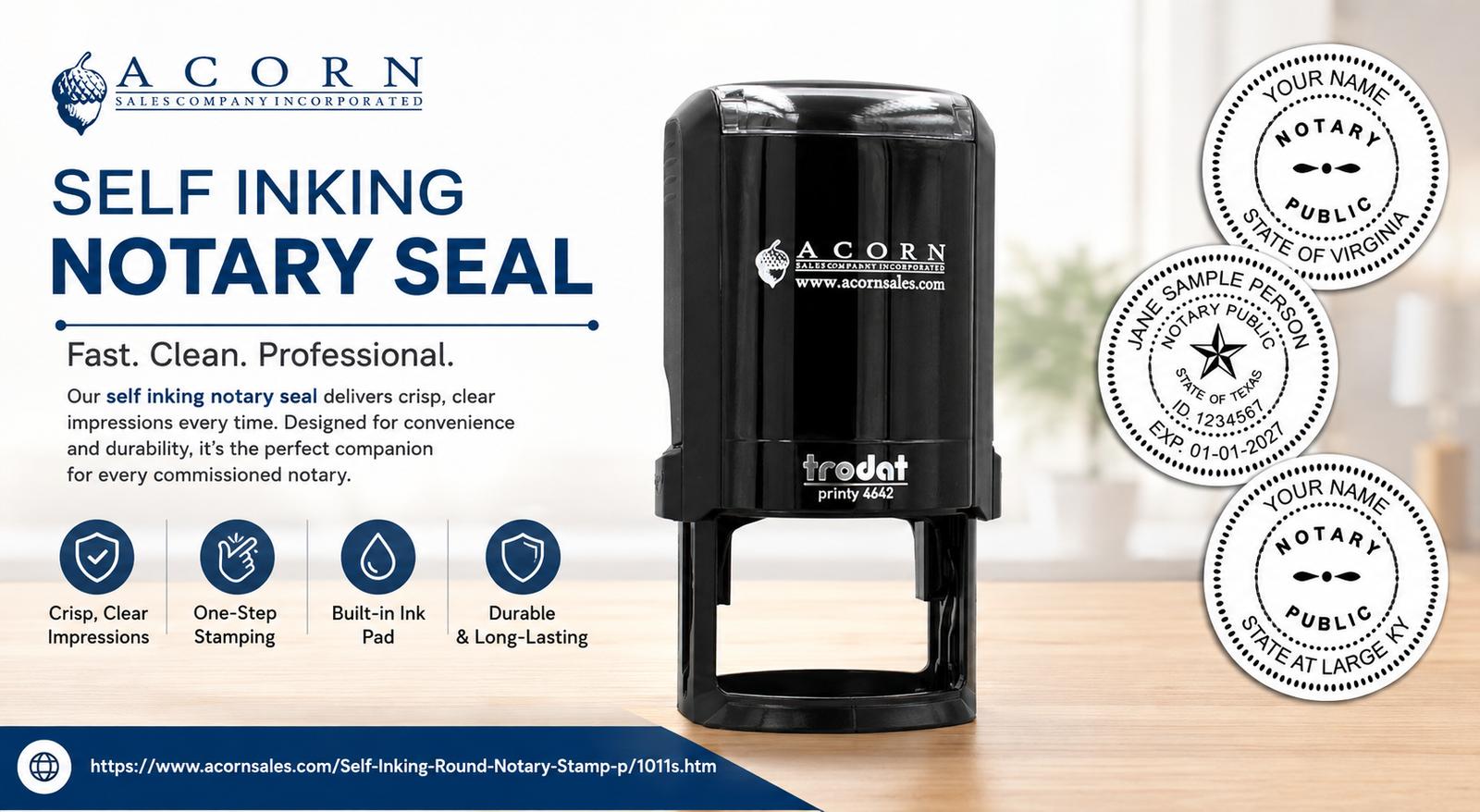
For notaries public, having the right tools can make everyday notarization tasks faster and more convenient. One of the most commonly used tools is a self inking notary seal, which combines the stamp mechanism and ink pad into one compact unit. Instead of reaching for a separate ink pad each time, a notary can press the stamp directly onto a document and create a clear impression.
But what exactly is a self inking notary stamp, how does it work, and what should a U.S. notary know before purchasing one? Understanding the basic features and applicable state requirements can help notaries choose a stamp that fits their professional needs.
What Is a Self-Inking Notary Seal?
A self inking notary seal is a notarial stamping device with an internal ink pad. When the stamp is pressed down, the stamping die rotates into contact with the built-in pad before making an impression on the document.
This design makes the stamping process convenient because the notary does not need to use a separate ink pad. After the impression is made, the stamp automatically returns to its original position, ready for the next use.
Depending on the jurisdiction, a notary seal may need to contain specific information such as the notary's name, commission details, state information, or other required elements. Because requirements differ across the United States, notaries should check the rules of their commissioning state before ordering a notary seal stamp.
How Does a Self-Inking Notary Stamp Work?
The basic operation of a self inking notary stamp is straightforward. Inside the housing is an ink pad and a stamping die containing the required notarial information.
When the notary presses the stamp onto a document:
- The stamping mechanism moves downward.
- The die contacts the internal ink pad.
- The inked die makes an impression on the document.
- The mechanism returns to its starting position.
- The stamp is ready for the next impression.
This built-in process is particularly useful when a notary handles multiple documents during a signing appointment. The compact design also makes a notary public stamp easy to store in a desk drawer, briefcase, or mobile notary supply kit.
What Information Is Included on a Notary Seal?
The information appearing on a notary seal depends on the requirements established by the state or jurisdiction where the notary is commissioned.
Common information can include:
- The notary's commissioned name.
- The words identifying the individual as a notary public.
- The state of commission.
- Commission number or expiration information where required.
- Other elements specified by the applicable state rules.
Notaries should not assume that a stamp approved for use in one state automatically meets the requirements of another. Notary seal requirements can vary, so checking the current instructions from the appropriate state authority is an important step before ordering a stamp.
Are Self-Inking Notary Seals the Same in Every State?
No. Notarial laws and notary stamp requirements can differ from state to state.
Some jurisdictions establish detailed specifications concerning the wording, size, layout, color, or other characteristics of a notarial seal. Other states may have different requirements or permit different types of notarial seals.
For this reason, a notary should verify the requirements of the state where they hold their commission. This is especially important when replacing an old stamp, renewing a commission, changing a commissioned name, or moving a commission to a different jurisdiction.
A practical approach is to review the current information provided by the state's Secretary of State, commissioning authority, or other official government agency.
How to Maintain a Self-Inking Notary Stamp?
Proper maintenance can help keep a self-inking stamp producing clear impressions.
Keep the stamp covered or stored in a clean location when it is not being used. Avoid exposing the mechanism to excessive dust, moisture, or heat. If impressions begin to appear faint, check whether the internal ink supply needs to be replenished.
Use the appropriate ink recommended for the stamp. Mixing incompatible inks can affect impression quality and may interfere with the stamping mechanism.
It is also useful to test the stamp on a blank sheet of paper after maintenance. This allows the notary to confirm that the complete seal impression is clear before using it on an official document.
Choosing the Right Self-Inking Notary Seal
When selecting a self inking notary seal, start by checking your state's current requirements. The stamp should contain the information required for your commission and produce an easily readable impression.
Next, consider the frequency of use. A notary who handles frequent appointments may value a durable construction and convenient re-inking system. A mobile notary may also prefer a compact design that can be carried easily between locations.
Finally, pay attention to impression clarity and overall build quality. A professional notary stamp should be easy to operate while producing consistent impressions on suitable documents.
Conclusion
A self inking notary seal provides a convenient way for notaries to create consistent seal impressions without using a separate ink pad. Its built-in mechanism, compact design, and straightforward operation make it a practical option for everyday notarial work.
Acorn Sales offers self-inking notary stamp options designed for professional use, giving notaries a convenient stamping solution while they focus on their document-signing responsibilities. Before purchasing any notary seal stamp, always verify the current requirements for your state to ensure the stamp contains the information and specifications required for your commission.
Frequently Asked Questions (FAQ)
What is a self-inking notary seal?
A self-inking notary seal is a stamp with an internal ink pad and stamping die. It automatically inks the die during the stamping process, eliminating the need for a separate ink pad.
How does a self inking notary stamp work?
The internal mechanism moves the stamping die against the built-in ink pad and then onto the document when the stamp is pressed. The die returns to its original position after the impression is made.
Do self-inking notary stamps need a separate ink pad?
Generally, no. A self-inking design contains its own internal ink pad, so a separate pad is not needed for normal stamping.
What are notary stamp requirements in the United States?
Notary stamp requirements vary by state. The required information, design specifications, and other rules should be verified with the appropriate state commissioning authority.
Is a self-inking notary seal accepted in every state?
Self-inking stamps may be used by notaries in many jurisdictions, but acceptance and specific seal requirements depend on state law. Notaries should confirm the current rules in their commissioning state.
Can a self-inking notary seal be re-inked?
Many self-inking stamps are designed with refillable or replaceable ink pads. The appropriate refill method depends on the specific stamp model.

 English
 French
 Spanish
 Portuguese
 Deutsch
 Turkish
 Dutch
Dutch
 Italiano
 Russian
 Romaian
 Portuguese (Brazil)
 Greek
Greek