


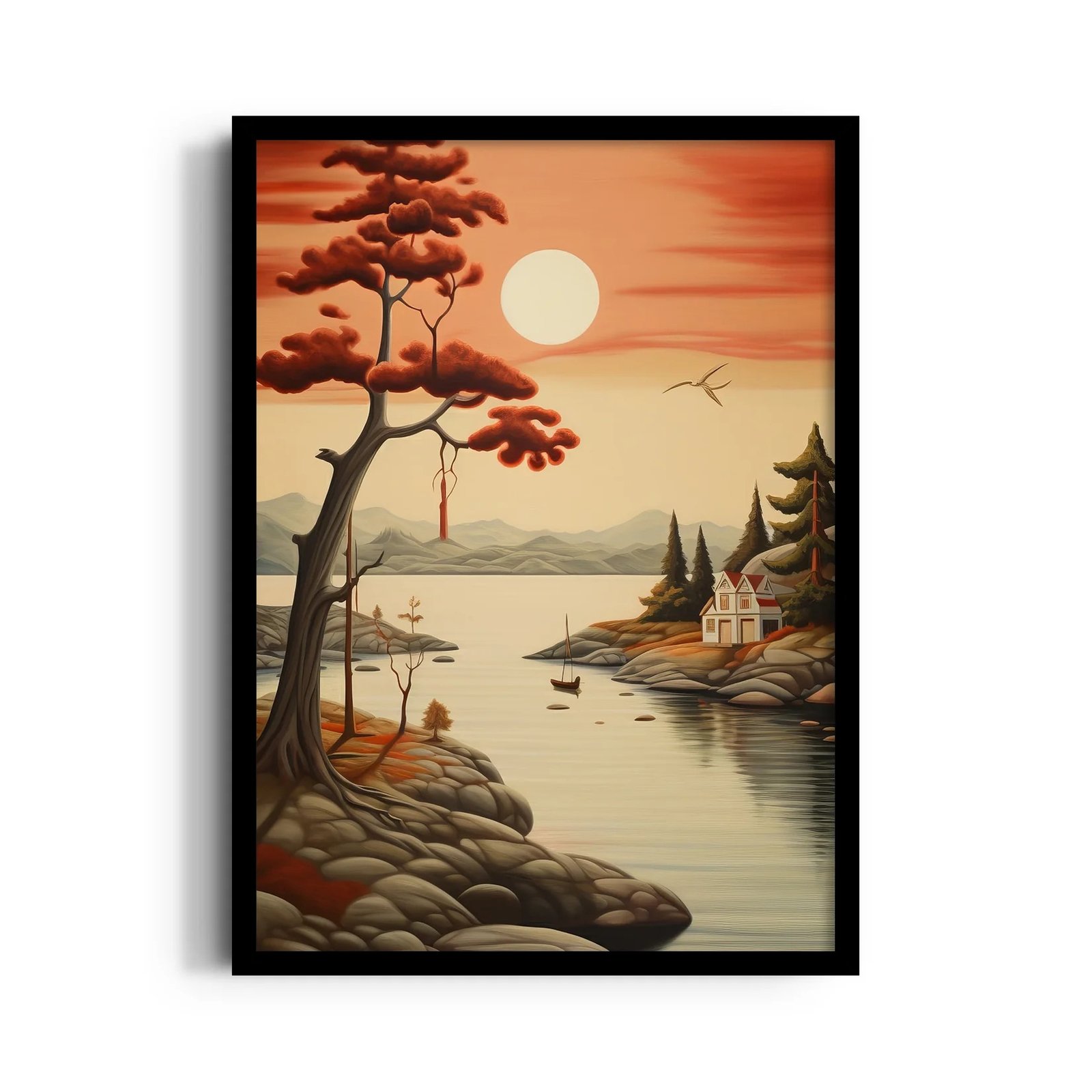
Artificial intelligence is transforming industries from healthcare to finance — and the art world is no exception. AI is now a creative tool, a disruptive force, and a conversation starter in the world of wall art. From generative algorithms that create entirely new visual compositions to personalisation engines that help buyers find the perfect piece for their home, AI is reshaping how art is made, discovered, and sold.
In this blog, we examine the ways artificial intelligence is influencing modern wall art design and what this means for artists, buyers, and the future of home décor.
AI as a Creative Tool for Artists
Many contemporary artists now use AI as one tool in their creative toolkit. Generative AI programmes can produce thousands of visual variations of a concept in seconds, providing artists with a starting point, a source of inspiration, or raw material that can be refined, modified, and brought into a finished work.
This does not replace the artist — it augments them. An artist working with AI brings their own aesthetic sensibility, emotional intelligence, and conceptual vision to guide and curate the outputs. The result is often work that would not have been possible through traditional means alone: compositions of extraordinary complexity, colour relationships of surprising subtlety, and structural arrangements that challenge conventional visual logic.
Abstract wall art has been particularly transformed by AI-assisted creation. Generative algorithms excel at producing swirling, complex abstractions with rich internal structures, creating work that echoes the visual language of human abstract expressionism while introducing qualities that are distinctly new.
AI-Personalised Art Recommendations
On the consumer side, AI is revolutionising how buyers discover and select wall art. Machine learning algorithms analyse a buyer's existing preferences, browsing behaviour, interior style signals, and colour preferences to surface art recommendations that genuinely resonate.
This reduces the overwhelming nature of browsing vast online catalogues. Rather than scrolling through thousands of options, a buyer is presented with a carefully curated selection that reflects their individual taste. The more the buyer interacts with the platform, the more precisely the AI learns their preferences.
For retailers and interior designers, this personalisation capability is transformative. It reduces the time and friction involved in art selection, increases buyer confidence, and leads to purchases that customers are genuinely happy with for years to come.
AI and the Democratisation of Art Design
One of the most profound effects of AI on the wall art market is democratisation. Tools that were once available only to professional designers and large studios are now accessible to independent artists, small studios, and even enthusiastic amateurs.
AI-assisted design tools enable creators to produce high-quality visual compositions, experiment with styles and techniques, and generate print-ready artwork at a fraction of the time and cost that traditional methods required. This has led to an explosion of new voices, new visual languages, and new styles entering the wall art market.
For buyers, this means more choice, more innovation, and more opportunities to find truly distinctive pieces that feel fresh and contemporary rather than derivative of existing trends.
AI and Nature-Inspired Art
Interestingly, some of the most compelling AI-generated art draws heavily from natural forms and landscapes. AI algorithms trained on vast datasets of photographs, paintings, and scientific imagery of the natural world have produced extraordinary works that echo the patterns found in nature — the branching of rivers, the cellular structures of leaves, the turbulence of clouds, the topography of mountain ranges — in new and unexpected ways.
These works bridge the gap between technological innovation and the timeless human love of the natural world. A Landscape Painting created with AI assistance can capture the emotional weight and visual poetry of a real landscape while introducing a visual dimension that no photograph or traditional painting could produce.
As AI tools become more sophisticated, we can expect nature-inspired wall art to become increasingly complex, nuanced, and emotionally resonant — reflecting both the capabilities of the technology and the enduring human desire for connection to the natural world.
The Ethics and Authenticity Debate
No discussion of AI and art would be complete without acknowledging the ongoing debate around authenticity, authorship, and ethics. Questions that the art world is actively grappling with include:
When an AI generates a visual composition, who is the artist — the programmer, the user of the tool, the AI itself, or some combination?
Is AI-generated art 'authentic'? Does it have the same value as work produced entirely by a human hand?
How should artists whose work was used to train AI models be credited and compensated?
These are important questions without easy answers, and the art world is still developing the frameworks needed to address them fairly. What is clear is that the conversation itself is enriching our understanding of creativity, authorship, and value in ways that will have lasting implications for how we think about art.
What This Means for Art Buyers
For buyers, the rise of AI in wall art design offers more options, more personalisation, and more innovation than ever before. At the same time, there is no substitute for art that carries genuine human intention, emotional depth, and craft.
The most thoughtful approach is to evaluate each piece on its own merits: Does it resonate with you? Does it work in your space? Does it reflect something true about your taste and values? Whether that piece was created by a human hand, an algorithm, or a collaboration between the two is ultimately secondary to the experience it creates in your home.

 Arabic
 French
 Spanish
 Portuguese
 Deutsch
 Turkish
 Dutch
Dutch
 Italiano
 Russian
 Romaian
 Portuguese (Brazil)
 Greek
Greek