


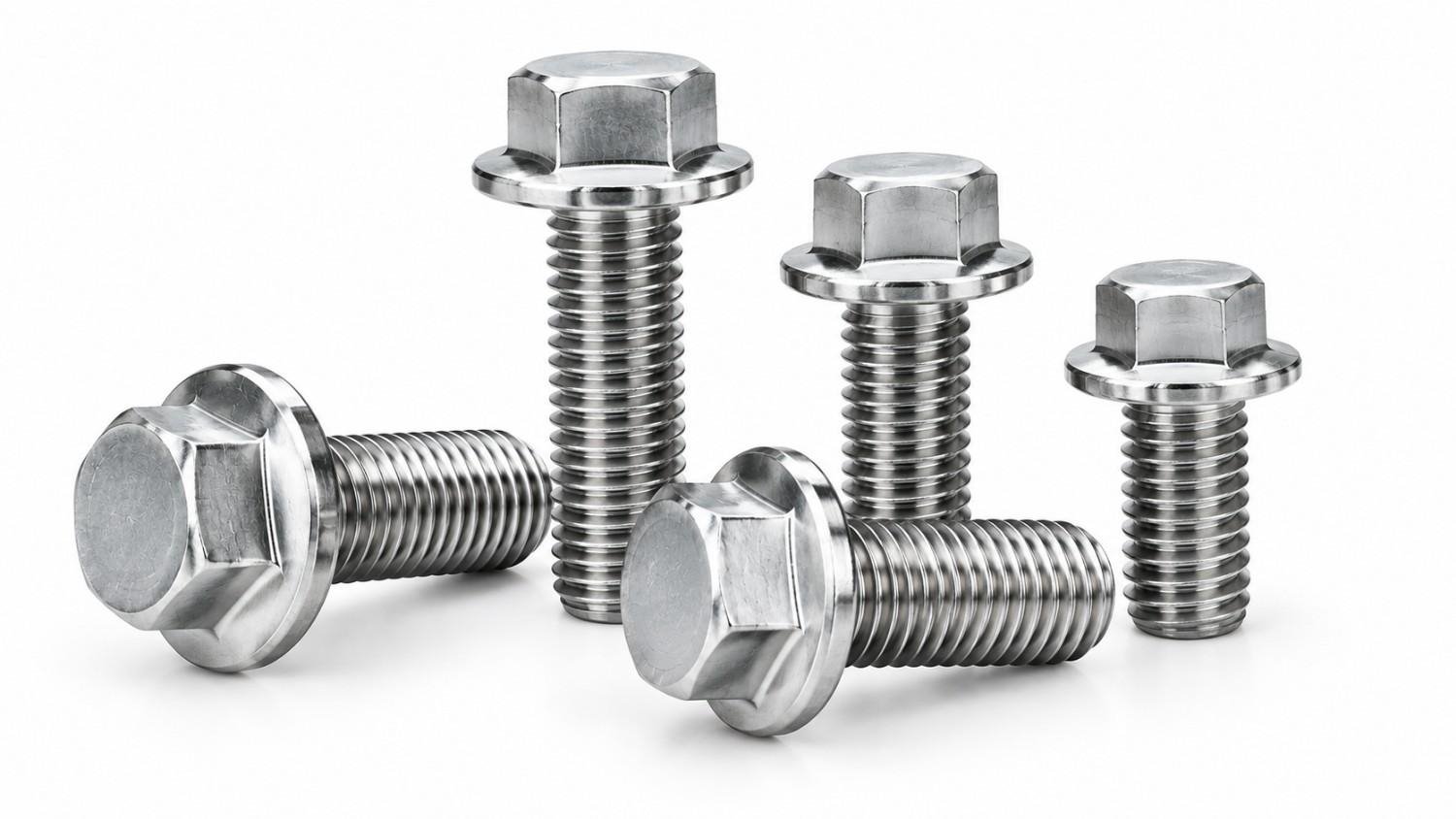
Two quotes arrive for the same part: a flange bolt, same size, same grade, same length. One is cheaper. It also says nothing about coating, flange form or friction. On an EV line that silence costs money, because flange bolts clamp battery enclosures, motor housings and inverter brackets that vibrate and cycle thermally for years, and your choice among flange bolt manufacturers decides whether the cheaper quote was a saving or a deferred problem.
The Parts of a Flange Bolt a Drawing Often Leaves Open
Length, pitch and property class get written down because everyone knows to; 8.8, 10.9 and 12.9 under ISO 898-1 are the usual reference points. The flange itself, the feature that sets flange bolts apart, gets skipped. Its diameter and thickness set the bearing area under the head, and the underside is either serrated or plain. Serrations resist back-off but can scar paint, coatings and soft aluminium, so the choice belongs to the joint, not a catalogue default. Where the drawing cites ISO 4162 or DIN 6921, require every quote to name it.
The overlooked one: friction
Torque only becomes clamp load when you overcame the friction. Now a coating that could change from batch to batch just changed your clamp load yet every measurement still passes.
Verifying a sample
Gauge the thread and head height, measure flange diameter and thickness, check hardness against the grade and request a test certificate tied to the batch. If clamp load is critical, tighten the bolt in your own joint, not a test fixture.
Reading Between the Lines of a Supplier's Replies
Whichever of the flange bolt manufacturers you approach, the first replies sound alike, and what follows each phrase is what separates them.
"Standard zinc plating."
Which process, applied by whom, and is friction measured? Torque settings hold only if it is. A supplier worth shortlisting names the process and shows test records; vagueness here is the early warning.
"The sample is on its way."
Check whether it came from production tooling and carries measured dimensions. Hand-finished samples flatter the bulk order. Be wary if it turns up faster than the bulk lead time would allow.
"We keep batch records."
Just one, show me. You should be able to view a decent record showing steel, heat treatment, coating lot, and carton is all associated to one batch number, meaning your field problem is one lot, not a quarter. “We blend lots to complete the jobs”...done.
“Nothing between orders has been altered.”
The tooling, the plating source, the steel source all will change at some point. What is important is the advance written notice so an approved sample continues to have meaning. A verbal commitment is not control.
"We're certified."
Open the scope and expiry, and see if it is ok with your customer’s quality needs. An expired or wrong one can delay approval after parts are produced.
What Tight Control Is Worth to Your Plant
The saving shows up in the plant, rarely on the quotation. Flange bolts specified this way give you:
-
Joint reliability: stable friction keeps torque settings valid batch to batch.
-
Margin protection: rework and field returns cost far more than the fastener.
-
Lower handling: no separate washer to pick, place or lose.
-
Narrower holds: batch-linked records confine a problem to one lot.
-
Faster purchasing: a fixed drawing and reference piece shorten each new quote.
-
Fewer transit claims: packing that protects coatings and serrations.
From Rajkot to Your Dock: What Moves the Schedule
Rajkot's engineering belt is a familiar fastener sourcing base, and Mundra is among the ports export cargo can use. Neither fact sets a delivery date. Lead time follows size, grade, coating and quantity, so treat any figure as unconfirmed until it is in writing. Coated variants and unusual flange forms can lengthen it and raise MOQ over plain standard parts. Settle packing before booking freight, since bolts rubbing in loose packing can abrade coatings and give a receiving team grounds for rejection.
A Few Facts About Us
We're Kiran Industries, in Shapar, Rajkot, and we've been in business since 1985. We're ISO-certified; read our certificate's scope and expiry the way you would anyone else's.
Tell Us About the Joint
Send us the bolt size and length, property class, flange type, coating, quantity, application, target market, packaging requirement and delivery location, plus whether you want samples first.
Last Word Before You Place the Order
EV designs keep changing, and the flange bolt manufacturers worth keeping flag a drawing gap before parts ship. Write coating, flange form and friction requirements into the purchase order instead of leaving them to a default. Revisions then start from a documented baseline instead of a supplier's habit.
Quick Answers for Procurement Teams
What should flange bolt suppliers see before they quote?
Flange type, coating, property class, torque or clamp-load target and the mating material. Without these, quotes cannot be compared.
Do aluminium housings need serrated flanges?
Not automatically. Serrations resist loosening but can mark soft surfaces, so test on the real mating face first.
Why do flange bolt wholesalers quote higher MOQ for coated parts?
Coating and special forms need process steps and MOQ may increase. Confirm it by specification in writing.
Can flange bolt dealers promise the same coating on every reorder?
Only if the order is tied to a documented process and a reference piece. Otherwise expect some variation.
How do flange bolts change assembly compared with a bolt plus washer?
One fewer part to feed and place. The trade-off: a flange does not replace a washer where the joint design calls for a specific one.
Is last year's approved sample still valid?
Only if tooling, plating source and steel source have not changed. Ask for written confirmation.

 Arabic
 French
 Spanish
 Portuguese
 Deutsch
 Turkish
 Dutch
Dutch
 Italiano
 Russian
 Romaian
 Portuguese (Brazil)
 Greek
Greek