


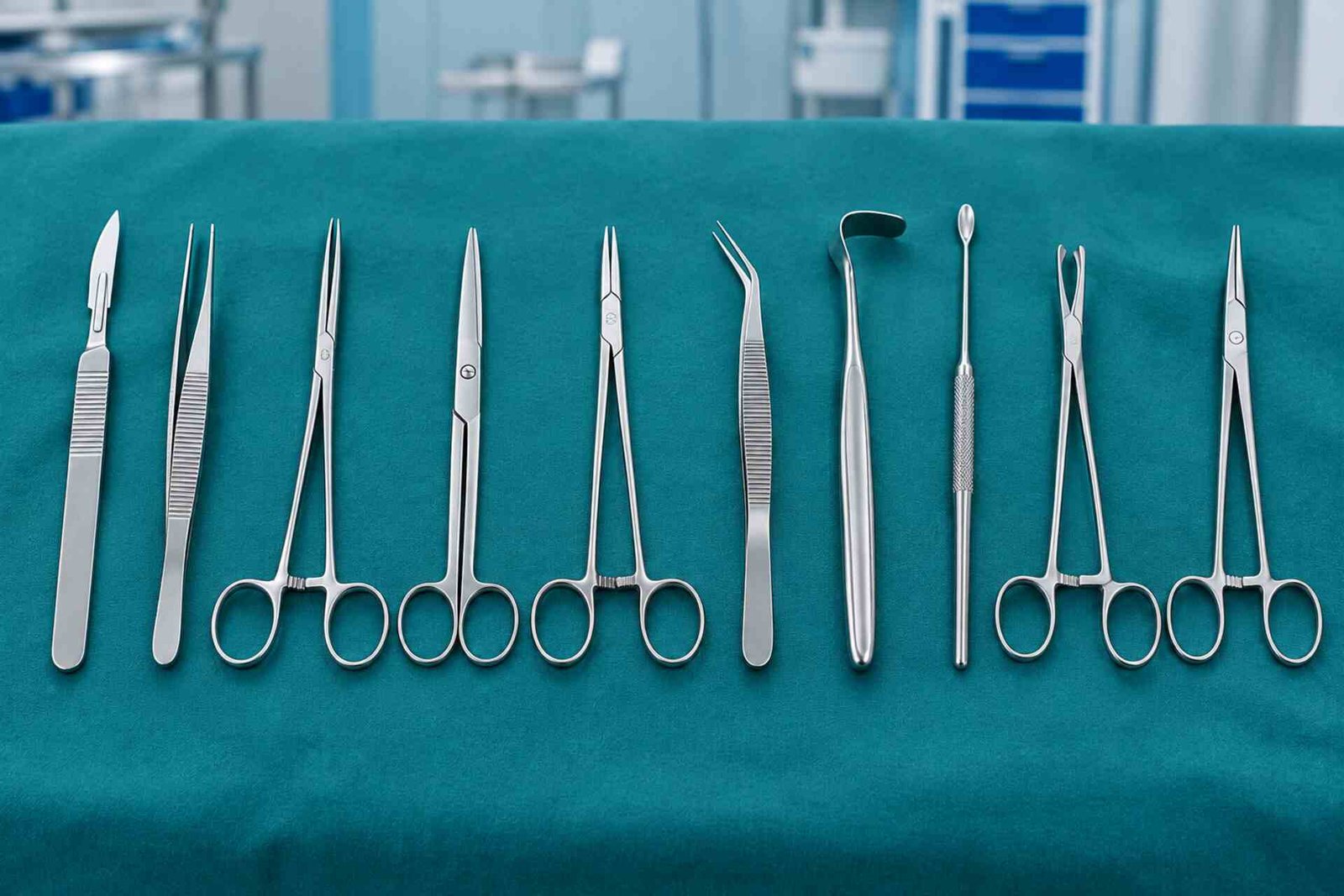
Picture a hospital sending back 400 forceps because the ratchets slip after the fifth autoclave cycle. Who absorbs that loss? Not the hospital. You do. Whether you buy as a wholesaler, procurement manager or brand owner, surgical instruments get judged by theatre staff and sterile-department technicians, not catalogue photos. Those people are stricter than they used to be. Here's what they check before a tray is approved.
What Surgical Instruments Must Survive Before Sign-Off
Every spec sheet for surgical instruments boils down to one test: does the tool still work after hundreds of sterilisation cycles? Steam autoclaves commonly run at 134°C, and weak steel or sloppy finishing shows up there first.
Steel Grade and the Passivation Step
ISO 7153-1 lists stainless steels for these tools; ASTM F899 covers wrought grades. Martensitic 420 suits cutting edges, while austenitic 304 or 316 suits retractors. Most buyers name the grade and stop. Skip passivation, though, and free iron on the surface becomes rust spots the sterile department will trace straight to you.
The Joint Detail Buyers Skip
Ask about box-lock tolerance.
A joint with play is where tray audits fail, and most quotes for surgical equipments never mention it. Holding it is harder than buyers expect, since hardening shifts dimensions slightly between lots.
Five Questions That Expose a Weak Supplier in One Call
Before ordering surgical instruments, put five checks to any surgical instruments supplier. Each bad answer below should end the conversation.
-
Certification. Ask for the current ISO 13485 certificate. Bad answer: "Renewal is in progress." Usually that means it lapsed.
-
Traceability. Does each batch carry a lot number? Bad answer: "Stock is mixed." Then you'll never learn which batch failed.
-
Material proof. Request mill test certificates. Bad answer: "Same steel as always."
-
Defect policy. Ask for it in writing. Bad answer: "We'll sort it out later." That isn't a policy; it's a dispute waiting on your loading dock.
-
Sample testing. Ask for production samples you can autoclave 100 times.
Where Margin Leaks, and What Verified Stock Prevents
Choosing on per-piece price alone is the classic buyer mistake. Good surgical instruments protect margin in ways a price list hides:
-
Fewer returns: freight and re-sterilisation claims can erase a whole carton's margin.
-
Faster tender approval: documented steel and lot records clear hospital audits sooner.
-
Matching reorders: consistent finish across lots stops mismatched sets.
-
Brand protection: your logo on a failed tool is your reputation, not the factory's.
-
Regulatory cover: India's Medical Devices Rules, 2017 bring devices under CDSCO oversight, so paperwork gaps become your problem too.
Why Jalandhar Is a Supply Chain Decision, Not Just an Address
Jalandhar is an established Punjab metalworking cluster where forging, grinding and plating sit close together. That's why many surgical instruments manufacturers in India base their works here: fewer hand-offs, shorter lead times. We serve as a surgical instruments supplier in India for surgical instruments dealers in India, each surgical instruments wholeseller in India and private-label brands. Find us at 1382/1046, Raja Garden, Basti Danishmandan, near Vishal Tools, Jalandhar – 144002, Punjab.
What 59 Years at the Jalandhar Bench Taught Us
We've made instruments since 1967, and we're ISO-certified. Here's what that history changed. We hand-check every box-lock joint before packing, because a joint can pass the drawing and still feel gritty in the hand.
Certificates get you in the door; that check keeps the order.
Send Us Your Spec Sheet and Target Quantity
Send us your instrument list or drawings, steel grade, finish, quantity and destination country. We reply within one working day with a quote and sample timeline. Our MOQ is 100 pieces per design.
What Hospital Buyers Will Ask Next
Expect hospitals to demand batch-level records for every tray, not just a certificate on the wall. Serious surgical instruments manufacturers already keep them, and buyers who ask early get the best production slots. Choose partners who can answer before you ask.
Questions Buyers Ask Us Before the First Order
Which certifications should surgical instruments manufacturers hold?
ISO 13485 at minimum, plus CE marking for Europe-bound orders. Certificates prove the system, not each batch, so ask for lot records too.
How do I vet a surgical instruments supplier I haven't met?
Verify the certificate number with the issuing body, then order samples. A video audit helps but can't replace a visit. If a supplier dodges both, walk away.
What separates surgical instruments dealers from manufacturers?
Dealers resell; manufacturers control steel and finishing. Dealers can be quicker for small mixed orders, but they rarely have process-level answers when a defect appears.
Is a surgical instruments wholeseller cheaper?
Per piece, usually, since volume spreads cost. The catch is mixed lots, which weaken traceability. Ask whether the lot data comes from the maker.
How should I test samples of surgical equipments before bulk ordering?
Run 100 autoclave cycles, then check joints, ratchets and finish. One caveat: bench testing can't predict every hospital's cleaning chemistry.
How long does a first order take?
Standard patterns move faster than custom ones. Anything needing new tooling takes longer, and I won't promise a date before seeing your drawing.
Is there a minimum order for surgical instruments dealers in India?
100 pieces per design is our floor. Smaller trial orders may be possible; send the list and we'll tell you plainly.

 English
 Arabic
 French
 Spanish
 Portuguese
 Deutsch
 Dutch
Dutch
 Italiano
 Russian
 Romaian
 Portuguese (Brazil)
 Greek
Greek