


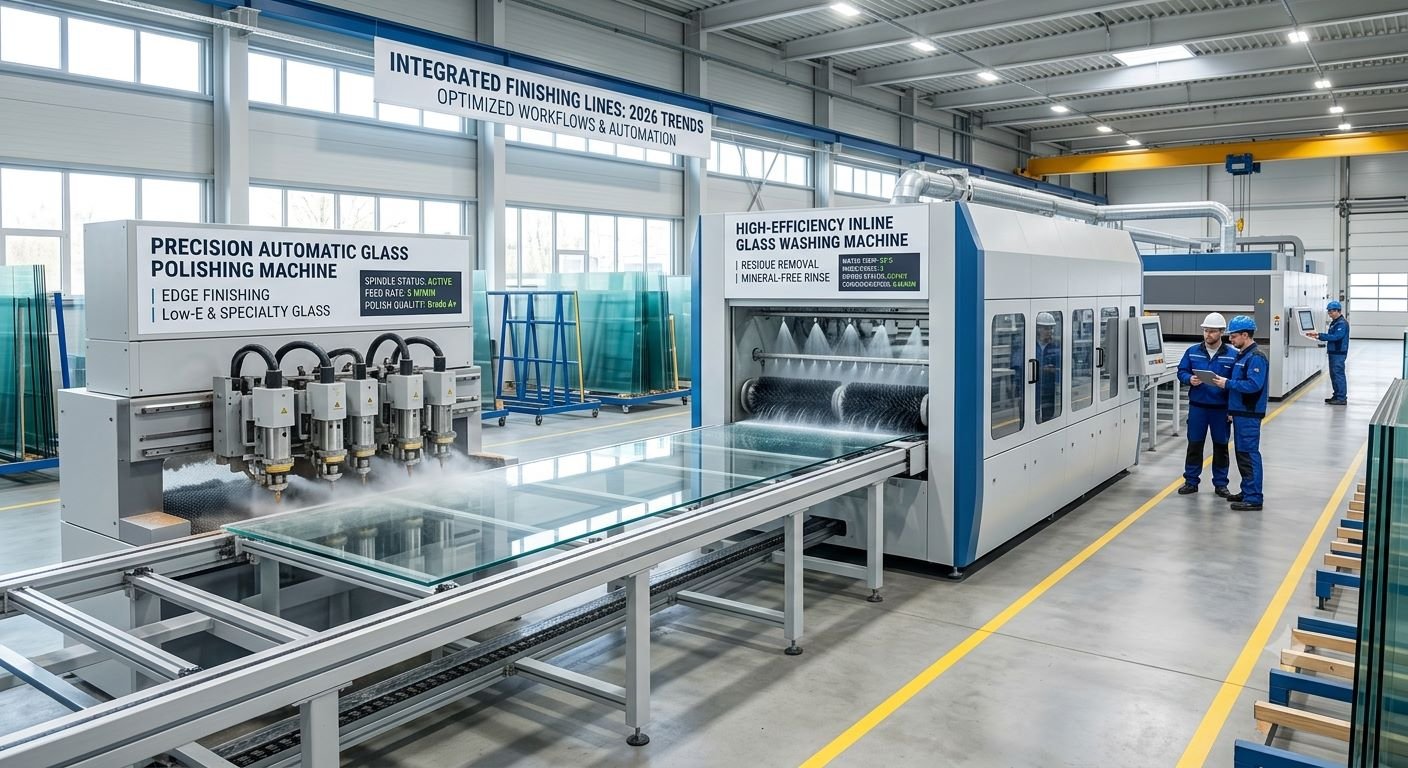
Glass manufacturing is no longer only about cutting sheets into the required dimensions. Customers now expect smooth edges, spotless surfaces, accurate finishing, and consistent product quality. This is why a glass polishing machine and glass washing machine have become essential equipment for modern glass processing facilities.
These machines perform different but complementary jobs. Polishing equipment improves edges and surfaces, while washing systems remove dust, oil, fingerprints, and processing residue before the glass moves to printing, coating, tempering, laminating, or final installation.
For manufacturers handling architectural glass, furniture glass, mirrors, doors, windows, automotive components, or decorative products, selecting the right machinery can improve productivity, product presentation, workplace efficiency, and quality control.
Understanding Modern Glass Finishing Equipment
Glass passes through several operations before becoming a market-ready product. Cutting often leaves edges that require additional treatment, while drilling, grinding, and handling can leave particles on the surface.
A glass polishing machine is designed to refine glass edges or surfaces after initial processing. Depending on the equipment configuration, it can perform grinding, smoothing, polishing, and finishing operations.
A glass washing machine, on the other hand, prepares the glass by removing contamination from its surfaces.
Together, these systems help create cleaner, safer, and professionally finished products.
How a Glass Polishing Machine Works
A glass polishing machine uses specialized grinding and polishing wheels to progressively remove rough material and develop a smooth finish.
The process usually begins with coarse grinding. Additional wheels then refine the edge before polishing wheels create the desired appearance.
Key Steps in Glass Polishing
-
Glass enters the processing section.
-
Grinding wheels remove sharp or uneven material.
-
Fine wheels improve edge consistency.
-
Polishing tools create a smooth surface.
-
Cooling water controls heat during processing.
-
Finished glass exits for inspection or further processing.
Modern systems may allow operators to control speed, thickness settings, pressure, and polishing parameters according to the glass type.
Why Edge Quality Matters
Poorly finished edges can affect both appearance and usability. Proper polishing creates a professional look while helping prepare components for furniture, architectural installations, partitions, doors, mirrors, and other applications where exposed glass edges are visible.
How a Glass Washing Machine Works
A glass washing machine combines water, brushes, conveying systems, and drying technology to clean glass consistently.
Glass normally moves horizontally or vertically through cleaning sections where rotating brushes remove contamination.
Typical Washing Process
The process may include:
-
Pre-rinsing
-
Brush cleaning
-
Water washing
-
Final rinsing
-
Air drying
-
Inspection before the next operation
A properly configured glass washing machine helps manufacturers avoid manual cleaning inconsistencies, especially when processing large quantities.
Glass Polishing Machine vs Glass Washing Machine
Although both machines contribute to quality, they perform completely different operations.
| Feature | Glass Polishing Machine | Glass Washing Machine |
|---|---|---|
| Primary Function | Grinding and finishing | Cleaning and drying |
| Main Target | Glass edges or surfaces | Glass surface contamination |
| Typical Tools | Grinding and polishing wheels | Brushes, water and air |
| Main Benefit | Smooth finished edges | Clean, residue-free glass |
| Production Stage | After cutting or shaping | Before or after further processing |
| Common Applications | Furniture, mirrors, doors | Tempering, coating, laminating |
Using both machines allows manufacturers to establish a more complete glass processing workflow.
Important Benefits of Glass Polishing Equipment
A reliable glass polishing machine can provide several operational advantages.
Consistent Edge Finishing
Automated processing helps maintain similar edge quality across multiple pieces instead of relying entirely on manual techniques.
Higher Processing Efficiency
Continuous glass processing can reduce the time required for individual edge-finishing operations.
Better Product Appearance
Smooth, polished edges are especially important for visible products such as shelves, tabletops, doors, partitions, and decorative panels.
Flexible Production
Different machine configurations can support straight edges, beveling, specialized finishing, and various glass thicknesses.
Advantages of Automated Glass Washing
Clean glass is essential before many downstream processes.
A modern glass washing machine offers benefits such as:
-
Consistent surface cleaning
-
Faster processing than manual washing
-
Reduced manual handling
-
Effective dust and residue removal
-
Improved preparation for coating or printing
-
More uniform drying
-
Better workflow organization
Cleanliness becomes particularly important before processes in which particles can affect bonding, coating, printing, or optical appearance.
Choosing the Right Glass Processing Machine
Purchasing equipment should be based on actual production requirements rather than machine size or price alone.
Manufacturers should evaluate several factors.
Production Capacity
Determine how many square meters or pieces of glass need to be processed during normal production.
Glass Dimensions
Maximum and minimum glass sizes influence machine configuration.
Glass Thickness
Verify that equipment can process the full thickness range used by your facility.
Automation Level
High-volume factories may benefit from automated loading, conveying, processing, and unloading systems.
Maintenance Requirements
Machines designed for accessible maintenance can reduce operational interruptions.
Supplier Support
Technical guidance, spare parts availability, installation assistance, and operator training can be as important as the equipment itself.
Applications Across Different Industries
A glass polishing machine and glass washing machine can support numerous manufacturing sectors.
Common applications include:
-
Architectural windows
-
Glass doors
-
Shower enclosures
-
Furniture glass
-
Mirrors
-
Display cabinets
-
Interior partitions
-
Automotive glass processing
-
Appliance panels
-
Decorative glass products
Each application may require different edge profiles, cleanliness standards, glass thicknesses, and production speeds.
Improving Quality Through Integrated Processing
Manufacturers can achieve better results when machines operate as part of an organized production line.
For example, glass may move through:
-
Cutting
-
Edge grinding
-
Polishing
-
Drilling
-
Washing
-
Drying
-
Inspection
-
Tempering or laminating
-
Packaging
Integrating a glass polishing machine with suitable washing and handling equipment can reduce unnecessary movement between workstations.
It can also improve production consistency by establishing standardized processing stages.
Safety and Maintenance Considerations
Glass processing involves rotating tools, water, electricity, and fragile materials. Proper operating procedures are therefore essential.
Operators should follow machine-specific safety instructions and wear suitable protective equipment.
Routine maintenance should include checking:
-
Polishing wheels
-
Water circulation
-
Conveyor components
-
Washing brushes
-
Air knives
-
Pumps
-
Electrical systems
-
Sensors and emergency controls
Preventive maintenance supports consistent performance and helps identify wear before it causes major production problems.
Sustainability and Manufacturing Efficiency
Modern glass processing businesses are increasingly focused on reducing unnecessary consumption.
Water recycling systems can support more efficient operation of a glass washing machine, while optimized polishing parameters can reduce unnecessary abrasive use.
Production planning can also decrease glass breakage and material waste.
Rather than viewing efficiency only as faster output, manufacturers should consider energy use, water management, consumables, maintenance requirements, and product rejection rates.
Future of Automated Glass Processing
Glass manufacturing is gradually moving toward smarter automation.
Future systems are expected to use more sensors, digital controls, production monitoring, automated material handling, and intelligent process adjustment.
A glass polishing machine may increasingly provide automated thickness detection and parameter control, while advanced washing equipment can improve water management, drying efficiency, and contamination monitoring.
Connected production lines can also make it easier to track output and identify bottlenecks.
Frequently Asked Questions
1. What does a glass polishing machine do?
It grinds, smooths, and polishes glass edges or surfaces to achieve a cleaner and more professional finish.
2. Why is glass washing necessary?
Washing removes dust, oils, fingerprints, abrasive residue, and other contamination before further processing.
3. Can one machine polish different glass thicknesses?
Many machines support multiple thicknesses, but the exact range depends on the model and configuration.
4. Where is polished glass commonly used?
It is widely used in furniture, mirrors, doors, partitions, shelves, architectural applications, and decorative products.
5. Can a glass washing machine dry glass automatically?
Many industrial washing systems include air-drying sections that remove moisture after cleaning.
6. Are polishing machines suitable for large-volume production?
Yes. Automated systems can be configured for continuous industrial production.
7. What should I check before buying glass machinery?
Consider glass size, thickness, production capacity, automation level, maintenance, energy requirements, and supplier support.
8. Does glass washing improve coating quality?
Clean surfaces can provide better preparation for coating, printing, laminating, and other processes where contamination may affect results.
9. How often should glass machines be maintained?
Maintenance frequency depends on production volume, machine design, and manufacturer recommendations. Regular inspection is important.
10. Can polishing and washing systems work in one production line?
Yes. They can form part of an integrated glass processing line alongside cutting, drilling, tempering, laminating, and inspection equipment.

 English
 Arabic
 French
 Spanish
 Deutsch
 Turkish
 Dutch
Dutch
 Italiano
 Russian
 Romaian
 Portuguese (Brazil)
 Greek
Greek