


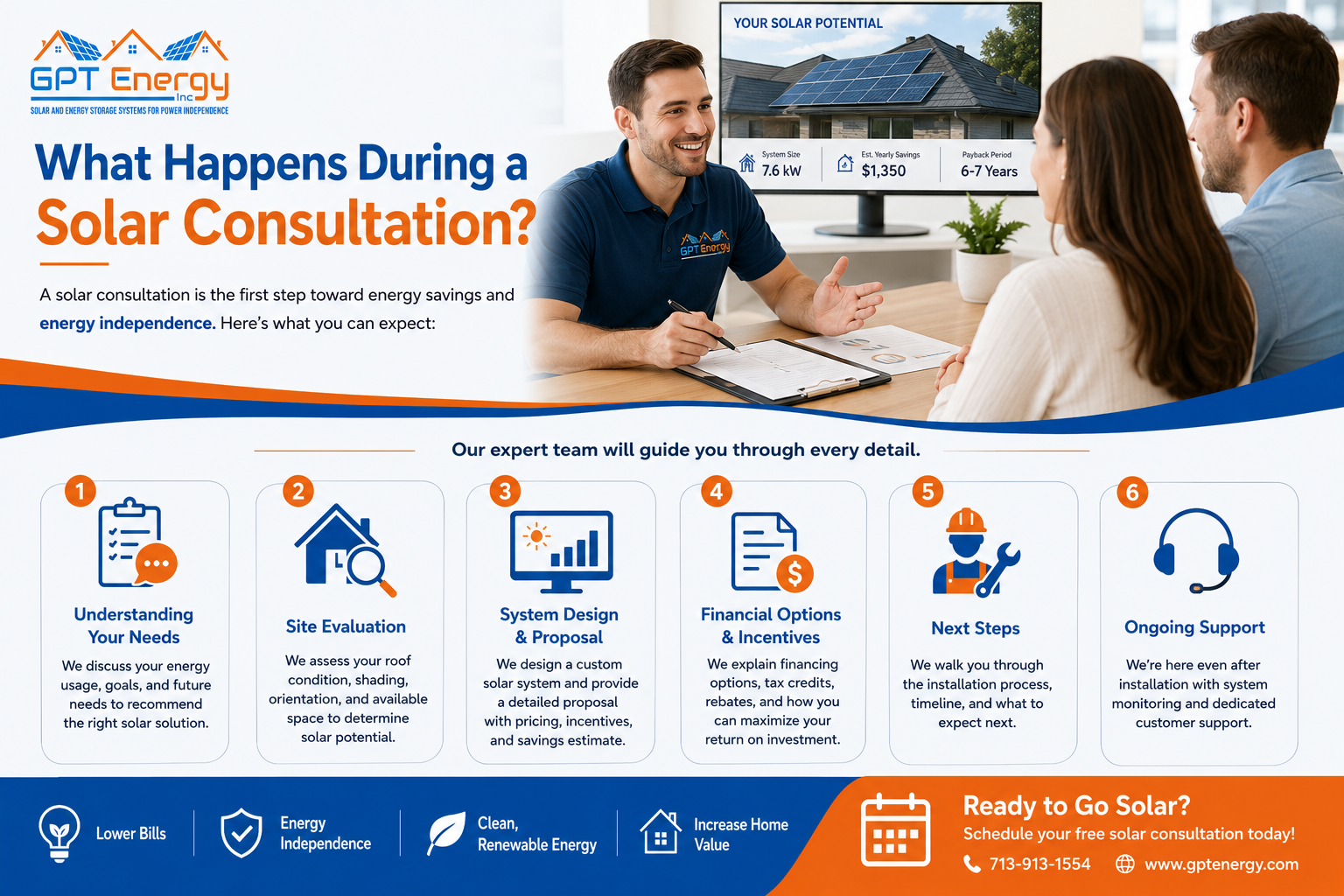
It often starts after a storm. The lights flicker, the power goes out. The house falls silent except for the hum of a backup generator somewhere down the street. You sit there wondering: Is there a better way to power this home? For many homeowners across Southeast Texas, that curiosity leads to scheduling a solar consultation. But before that meeting happens, there’s often uncertainty. What actually takes place during the conversation? Is it complicated? Is it a sales pitch?
The reality is much simpler. A solar energy consultation is primarily about understanding your home, your electricity use, and whether solar power realistically fits your goals. It’s less about selling and more about planning.
Key Takeaways
- A solar consultation helps determine how much energy your home uses and how solar could support it.
- Homeowners typically bring recent utility bills so the advisor can understand energy patterns.
- The advisor reviews a customized solar design and discusses purchase options.
- The goal is clarity, helping homeowners decide whether solar fits their energy goals.
What is A Solar Consultation?
It is a planning session where a solar advisor reviews your home’s energy usage and proposes a custom solar system designed for your needs. Most consultations today happen through a simple video call. The process is surprisingly straightforward and usually takes under an hour. Instead of complicated engineering talk, the focus stays on three things:
- Your home’s energy habits
- The potential solar design for your roof
- Financial options that could make the system work
Think of it as the discovery phase of your solar journey.
Step 1: Reviewing Your Home’s Energy Usage
The first thing your advisor usually asks for is recent utility bills. Ideally, homeowners bring the last 12 months of electricity bills. Why so many? Energy use changes throughout the year. Air conditioning in the summer and heating in winter can shift electricity needs dramatically.
Your advisor studies the pattern to estimate how much solar power your home might need. This is the foundation of the entire solar energy consultation. According to the U.S. Energy Information Administration, the average American home consumed about 10,791 kilowatt-hours of electricity in 2022. Source: https://www.eia.gov/tools/faqs/faq.php?id=97&t=3. However, every household is different. Some homes use far more energy depending on:
- Pool pumps
- Electric vehicles
- Large families
- Home offices
This early step ensures the solar design actually matches your lifestyle.
Step 2: Designing A Custom Solar System For Your Home
Once your energy usage is clear, the advisor presents a customized proposal. This typically includes a visual layout showing where panels would sit on your roof and how much energy they might produce. The goal isn’t just hiring solar panel installers to install panels; it’s designing a solar power system that matches your home’s real energy needs. A good design considers several factors:
- Roof direction and tilt
- Shade from trees or nearby buildings
- Local weather patterns
- Your electricity consumption
At this stage, homeowners often realize something important: solar isn’t a one-size-fits-all technology. It’s a custom energy system.
Step 3: Exploring Purchase And Financing Options
After reviewing the system design, the next part of the consultation focuses on how homeowners might pay for the system. The advisor usually presents two common paths:
Cash Purchase
Homeowners pay for the system upfront. This option often provides the strongest long-term financial return.
Solar Financing
A monthly loan spreads the cost over time. Many homeowners prefer this because payments may be comparable to existing electricity bills. The purpose of the consultation isn’t to push one option; it’s to help homeowners understand which approach fits their budget and goals.
Step 4: Understanding Battery Backup Options
This part of the conversation becomes important for homeowners concerned about outages, especially in hurricane-prone areas. Your advisor may discuss a solar battery system that stores excess solar energy.
When the power grid goes down, that stored energy can keep essential parts of the home running. This is particularly appealing in regions where storms or winter freezes occasionally disrupt the grid. Solar panels generate electricity during the day. Batteries allow you to keep using that energy when the sun goes down or when the grid fails.
What Many Homeowners Misunderstand
Sometimes people assume a consultation will be complicated or aggressive. In reality, it’s mostly educational. Here’s a helpful way to think about it:
| What people expect | What actually happens |
| A high-pressure sales call | A conversation about energy usage |
| Confusing technical jargon | Clear visual explanations |
| A generic solar quote | A customized system proposal |
| Immediate decision required | Time to review and consider |
As inventor Thomas Edison once said: "Most people miss opportunity because it is dressed in overalls and looks like work." Understanding solar panel installation might take a little learning, but the reward can be long-term energy resilience.
A Familiar Homeowner Scenario
Let’s say a family in Southeast Texas loses power during a tropical storm. The outage lasts almost two days. They begin researching solar, not just for savings, but for resilience.
During their consultation, the advisor reviews their electricity bills, designs a custom system for their roof, and explains how a battery could keep refrigerators, lights, and internet running during outages. By the end of the call, the homeowners haven’t committed to anything yet, but they finally understand their options, and that clarity is the real purpose of a consultation.
The First Step Toward Energy Independence
The journey toward solar doesn’t start on the roof for many homeowners. It starts with a conversation. A thoughtful consultation helps homeowners understand how much energy they use, what solar might produce, and whether the investment aligns with their long-term goals.
It replaces uncertainty with information, and for households looking for resilience during storms, relief from rising electricity prices, or simply more control over their power supply, that conversation can be the first meaningful step. Homeowners interested in exploring their options can begin with a solar energy consultation through brands like GPT Energy Inc, where advisors help design solar solutions tailored to each home.
FAQs
1. What makes a good consultation?
A good consultation focuses on your actual energy use, explains system design clearly, and provides realistic financial options without pressure.
2. What are the best practices before scheduling a consultation?
Gather at least 12 months of electricity bills, think about your long-term energy goals, and prepare questions about battery backup and financing.
3. How to prepare for a solar energy consultation?
Have your recent utility bills ready and consider whether your goal is lowering electricity costs, gaining backup power, or becoming more energy independent.
4. When to hire a solar advisor?
Homeowners typically schedule a consultation when electricity prices rise, after experiencing outages, or when planning long-term home upgrades.
5. What services are typically discussed in a consultation?
Advisors usually review solar panel placement, estimated energy production, financing options, and potential battery storage.

 English
 Arabic
 French
 Spanish
 Portuguese
 Deutsch
 Turkish
 Italiano
 Russian
 Romaian
 Portuguese (Brazil)
 Greek
Greek