


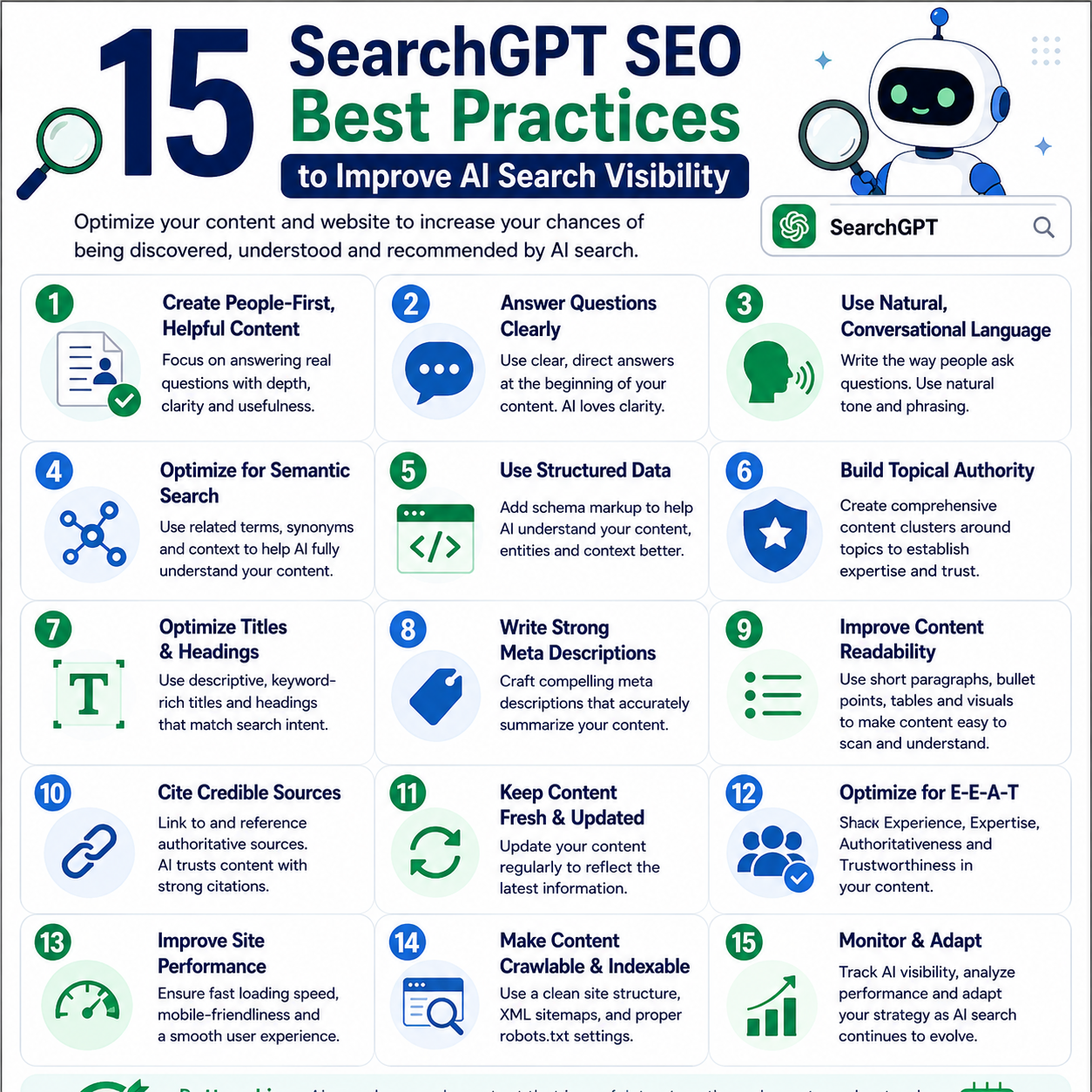
The way people search is changing faster than most businesses realize. SearchGPT and AI-powered search interfaces are no longer experimental features sitting on the sidelines. They are becoming the primary layer through which millions of users discover information, make decisions, and evaluate brands. If your digital marketing services strategy still revolves entirely around traditional ranking signals, you are already behind.
This guide walks you through 15 actionable SearchGPT SEO best practices that help your content get picked up, cited, and surfaced by AI search engines. These recommendations are grounded in Google's Search Quality Evaluator Guidelines (SQEG), which remain the clearest published signal of what search systems, including AI-powered ones, are designed to reward.
-
Build Real E-E-A-T Into Every Page
Experience, Expertise, Authoritativeness, and Trust are not just Google buzzwords. They are the backbone of how AI search systems evaluate content quality. SearchGPT pulls from sources it considers reliable. Show first-hand experience in your content through case studies, real results, and named authors with verifiable credentials. A page that demonstrates genuine expertise outperforms generic content every time.
-
Answer the Actual Search Intent Clearly
AI search engines are intent-matching machines. Before you write, identify whether your audience wants to know something, do something, or find something specific. Match your opening paragraph directly to that intent. SearchGPT rewards content that satisfies the user's need without making them scroll endlessly or click away.
-
Prioritize Trust Signals Above Everything Else
According to the SQEG, Trust is the most important member of the E-E-A-T family. A page with strong expertise but low trustworthiness still scores poorly. For SearchGPT SEO, this means publishing accurate information, linking to credible sources, maintaining a clean website reputation, and ensuring your About page, contact details, and author bios are complete and verifiable.
-
Structure Content for AI Parsing
SearchGPT reads content the same way a careful editor does. Use clear H2 and H3 headings that directly reflect what each section covers. Avoid burying your key answer three paragraphs down. AI systems extract answers from well-structured, logically organized content. Bullet points, numbered lists, and short paragraphs all help your content get parsed and cited accurately.
-
Optimize for Conversational Queries
Users asking AI search engines do not type in keywords the way they did in 2015. They ask full questions in natural language. Your content should mirror this pattern. Include question-and-answer sections, FAQ blocks, and naturally worded subheadings that reflect how real people phrase their searches when they are looking for searchgpt seo guidance.
-
Cover Topics with Depth and Originality
Thin content gets ignored by AI search. Surface-level articles that repeat what every other page says offer no value to an AI system trying to serve users well. Go deeper. Add proprietary insights, original data, worked examples, and analysis that readers cannot find anywhere else. This is what separates content that gets cited from content that gets bypassed.
-
Keep Your Information Current
AI search systems deprioritize outdated information, especially on fast-moving topics like google search updates, AI search behavior, and digital marketing. Review and refresh your key pages regularly. Add a "Last Updated" date. Update statistics, remove obsolete advice, and add new sections as the landscape evolves. Content that stays current signals an active, reliable publisher.
-
Earn and Build High-Quality Backlinks
Authoritative inbound links remain a strong signal across traditional and AI-powered search. They tell search systems that other credible sources trust your content enough to reference it. Focus your link-building efforts on industry publications, partner sites, and earned media rather than directories or low-quality placements. The best seo company you could partner with would tell you the same thing.
-
Make Your Author Credentials Visible
SearchGPT pays attention to who created the content. Add detailed author bios with professional background, areas of expertise, and links to their professional profiles. For YMYL-adjacent topics like marketing ROI or business strategy, credentials matter more. A named expert with a visible track record signals trustworthiness to AI systems evaluating page quality.
-
Use Schema Markup to Communicate Context
Structured data gives AI search systems direct signals about what your content is, who wrote it, when it was published, and what it covers. Implement Article, FAQPage, HowTo, and Organization schema where relevant. SearchGPT can surface rich, cited results more easily from pages that clearly communicate their context through structured markup.
-
Build a Topical Authority Hub
AI search engines favor publishers who demonstrate deep, consistent coverage of a topic rather than scattered content across random subjects. Build content clusters around your core topics. A strong pillar page supported by related supporting articles signals to SearchGPT that your site is the authoritative destination for that subject area. This is a proven model for improving AI search visibility over time.
-
Earn Mentions Across Trusted Third-Party Sources
SearchGPT does not evaluate your content in isolation. It evaluates your reputation across the web. Reviews, mentions in industry publications, social proof, and citations from credible external sources all feed into how AI systems perceive your authority. Actively pursue PR, guest contributions, and community engagement to grow your brand's footprint in places that matter.
-
Optimize Page Experience and Core Web Vitals
Slow, unstable, or difficult-to-navigate pages create poor user experiences. AI search systems are designed to serve users well, which means they are unlikely to consistently surface pages that frustrate visitors. Ensure your pages load fast, are mobile-responsive, and are free from intrusive popups or layout shifts. A technical foundation that respects user experience supports your SearchGPT visibility goals.
-
Write for Humans, Not Algorithms
One of the clearest lessons from the SQEG is that high-quality pages are designed to serve people, not to manipulate rankings. SearchGPT is trained to identify and deprioritize content that feels manufactured or keyword-stuffed. Write naturally. Use your target terms where they fit organically. Let the value of your content drive visibility rather than forcing keywords into every paragraph.
-
Align Your Content Strategy With Google Search Updates
SearchGPT SEO does not exist in a vacuum. It overlaps significantly with the signals that Google's own systems have been reinforcing through recent core updates, particularly around helpful content, E-E-A-T, and spam. Following google search updates closely and adapting your strategy accordingly keeps your content aligned with the direction AI search is heading. What rewards users genuinely helpful answers today will continue to do so as these systems evolve.
If you are serious about growing your visibility in AI search, SEO Discovery brings over 22 years of search expertise and a team of 400+ specialists who understand both traditional and next-generation SEO. Our digital marketing services are designed to help businesses adapt and lead in the era of AI-powered search. Reach out to our team today to discuss a strategy built for where search is going, not just where it has been.
SearchGPT SEO is not a replacement for sound content fundamentals. It is a sharpening of them. The businesses that will lead in AI search are the ones that focus on genuine expertise, clear communication, and trustworthy content. Apply these 15 best practices consistently and you will be well-positioned to capture visibility as AI search becomes the dominant discovery channel.

 English
 Arabic
 French
 Spanish
 Portuguese
 Deutsch
 Turkish
 Dutch
Dutch
 Russian
 Romaian
 Portuguese (Brazil)
 Greek
Greek